The Price of a Quieter Gulf
Markets have already decided the Iran war is over. The negotiators in Doha haven't. Covering the week of June 29 to July 5, 2026.
Four months after the Middle East conflict sent crude oil and inflation expectations vertical, oil is back where it started. That single fact shaped almost everything else this week, from the Federal Reserve's newfound patience to the ECB's quiet sense of vindication. The question worth asking: if peace is already in the price, what happens if the talks stumble?
1. Doha: pricing peace before it exists
Indirect US-Iran negotiations in Qatar wrapped their second day with mediators calling the progress "positive", which is about as warm as language gets in this format. On the table: unfreezing Iranian assets, and a US push to stop Tehran introducing tolls on ships transiting the Strait of Hormuz. The nuclear question is queued up next, which is where things traditionally fall apart.
Meanwhile the physical market has moved on. Commercial shipping through Hormuz keeps recovering, Saudi crude exports are back to roughly 90% of pre-war volumes, and crude oil settled near $67 to $69, levels last seen before the conflict erupted in late February. Talks now pause for the multi-day funeral of former Supreme Leader Ali Khamenei (July 4 to 9), with the next round promised "at the earliest possible time" after.
The read: the market is treating de-escalation as done. That makes the risk asymmetric. A signed framework adds little upside to oil-sensitive assets from here, while a breakdown (or an Iranian toll booth in Hormuz, which Tehran pointedly kept alive this week by warning ships onto designated routes) would reprice quickly. Cheap optionality is on the pessimistic side.
2. America's strange jobs report
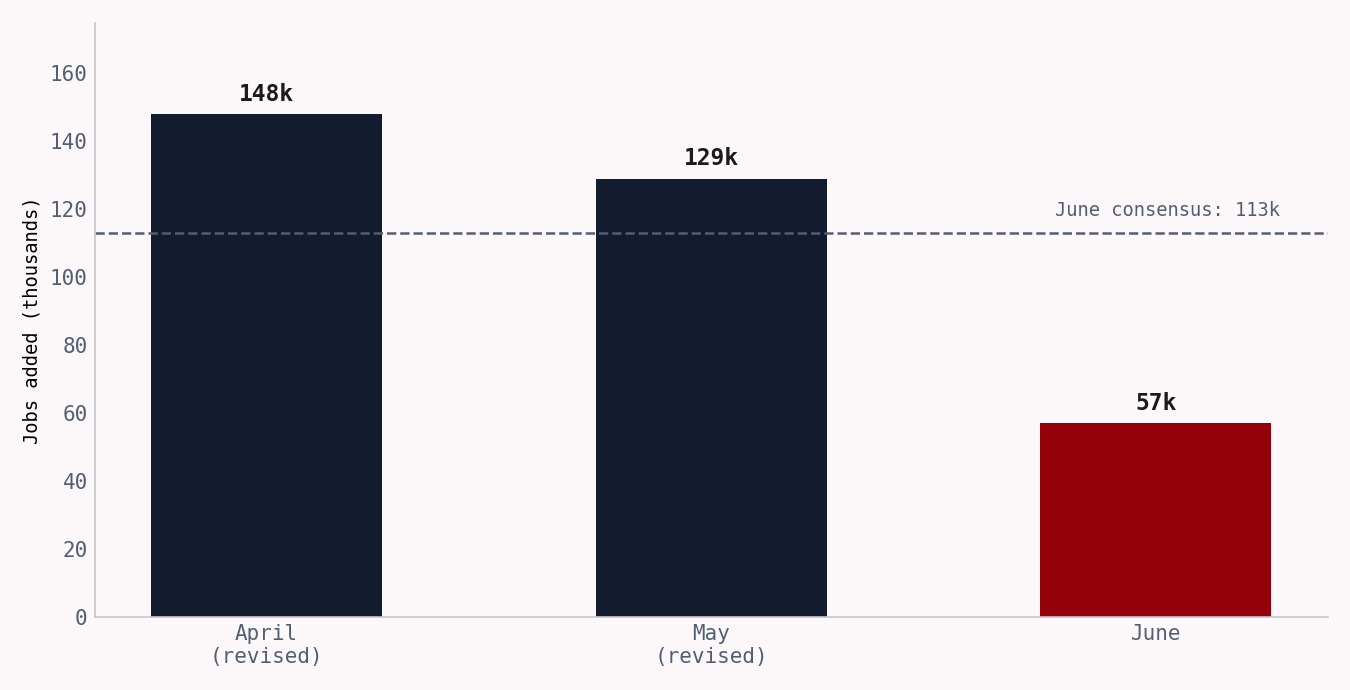
US payrolls rose just 57,000 in June, barely half the 113,000 expected, and April and May were revised down by a combined 74,000. Yet unemployment fell to 4.2%, and equities rallied into the holiday: the S&P 500 gained 1.8% on the week, the Nasdaq 2.1%, and the Dow rose 2% to a record.
Why does bad news read as good news? Because the Fed's problem right now is inflation, not growth. Having held rates at 3.50% to 3.75% in June while its dot plot leaned toward hikes (a war-driven inflation spike does that), the committee gets cover from a cooling labour market to simply wait. Futures now price an 80% chance of a hold this month and a 46% chance of a hike by autumn, down from 50% before the report.
Under the rally's surface, though, the AI trade wobbled: Micron fell 7%, Applied Materials 7.4%, and AMD 4.3% over two sessions as investors openly questioned chip valuations. A record Dow powered by "traditional" sectors while semis sell off is rotation, not euphoria. Worth watching whether it has legs.
3. The ECB's quiet vindication
Three weeks ago the ECB raised rates by 25 basis points, its first hike since September 2023, and took criticism for tightening into a fragile recovery. June's data will feel like vindication in Frankfurt: euro-area inflation dropped to 2.8% from 3.2%, well below the 3.0% expected, with energy (8.7%, from 10.8%), services and food all decelerating. Core fell to 2.4%.
Policymakers spent the week signalling there's "no rush" for a follow-up, and falling oil does much of their work for them. The awkward corner of the continent is Italy: inflation at 3.1% is now above the bloc's average while growth slowed to 0.2% in the first quarter: the uncomfortable combination of pricier living and a stagnant economy, with none of the monetary levers in Rome's hands.
4. Ukraine: escalation in both directions
While attention fixed on the Gulf, the war in Europe had one of its most dangerous weeks in months. Russia launched a massive missile and drone strike on Kyiv on July 2, killing at least eight people; Poland scrambled jets and Finland restricted airspace along the frontier. Ukraine, for its part, has stepped up long-range drone strikes on Russian refineries and cities, including Moscow, and raised its flag on the Kinburn Spit for the first time since 2022.
On the ground, Russia gained roughly 31 square miles in June: modest, but an acceleration. The pattern is a war intensifying at both ends while the diplomatic track stays frozen: exactly the opposite of the Gulf. Energy markets have largely stopped pricing Ukraine risk; refinery strikes deep inside Russia are the kind of thing that could change that.
US nonfarm payrolls, monthly change · Source: BLS via CNBC
Week of June 29 to July 5, 2026
- 57,000
- US jobs added in June (vs 113k expected)
- 2.8%
- Euro-area inflation, down from 3.2%
- ~$69
- Crude oil, back to pre-war levels
- 90%
- Saudi exports vs pre-war volumes
- 46%
- Market odds of a Fed hike by autumn
The week ahead
- July 4 to 9: Khamenei funeral ceremonies in Iran; Doha talks resume after. Watch tanker traffic and shipping-insurance rates in Hormuz as the honest signal.
- US markets: reopen Monday after the Independence Day break; Fed speakers return and every one will be asked about the jobs miss.
- Mid-July: Q2 earnings season approaches. Chip-sector guidance will decide whether this week's semi selloff was a blip or a turn.