The Side Doors
For a month the market has watched one strait and priced one risk. This week the damage arrived through a different sea, a European storage report and an American wholesale price index. Covering the week of July 20 to 26, 2026.
Hormuz has been the whole conversation since the fighting resumed. Transit counts, war-risk premiums, the tanker traffic maps that every desk now has open in a spare tab. It is a reasonable obsession, and it has also made everyone slightly blind. Brent crossed $100 this week for the first time in this conflict, and the reason had almost nothing to do with the strait that markets have been staring at. Meanwhile Europe's economy accelerated while its gas storage sat fifteen points below normal, and American producer prices kept running about two points hotter than consumer prices. Three pressures, none of them arriving through the door that was being watched.
1. The war changes sea
On Thursday the Houthis claimed strikes on two Saudi oil tankers in the Red Sea, and the market finally moved the way a month of Hormuz headlines had failed to make it move. Brent topped $100 on July 23 and opened Friday at $100.57, before sliding back to about $98.38 as traders read a flurry of contradictory reports about the stalled American and Iranian talks. Up roughly 10% on the week either way. Seven vessels changed course to avoid the Bab el-Mandeb, the twenty-mile gap between Yemen and Djibouti that funnels Suez traffic into the Gulf of Aden.
President Trump said Washington would hold Tehran responsible for whatever the Houthis do next, and CENTCOM ran a thirteenth consecutive night of strikes on Iranian command centres and drone storage. Note what changed in the target list. Not American warships, not Israeli ports. Saudi tankers.
The read: hitting Saudi hulls is a way of attacking the spare capacity everyone has been counting on without ever going near Hormuz. The cushion is only useful if the barrels can leave, and a shipowner who reroutes around the Cape adds two weeks and a much larger insurance bill to every cargo. The strait stayed open all week and oil still went through $100. That should tell you where the binding constraint actually sits.
2. Europe picks a strange moment to grow
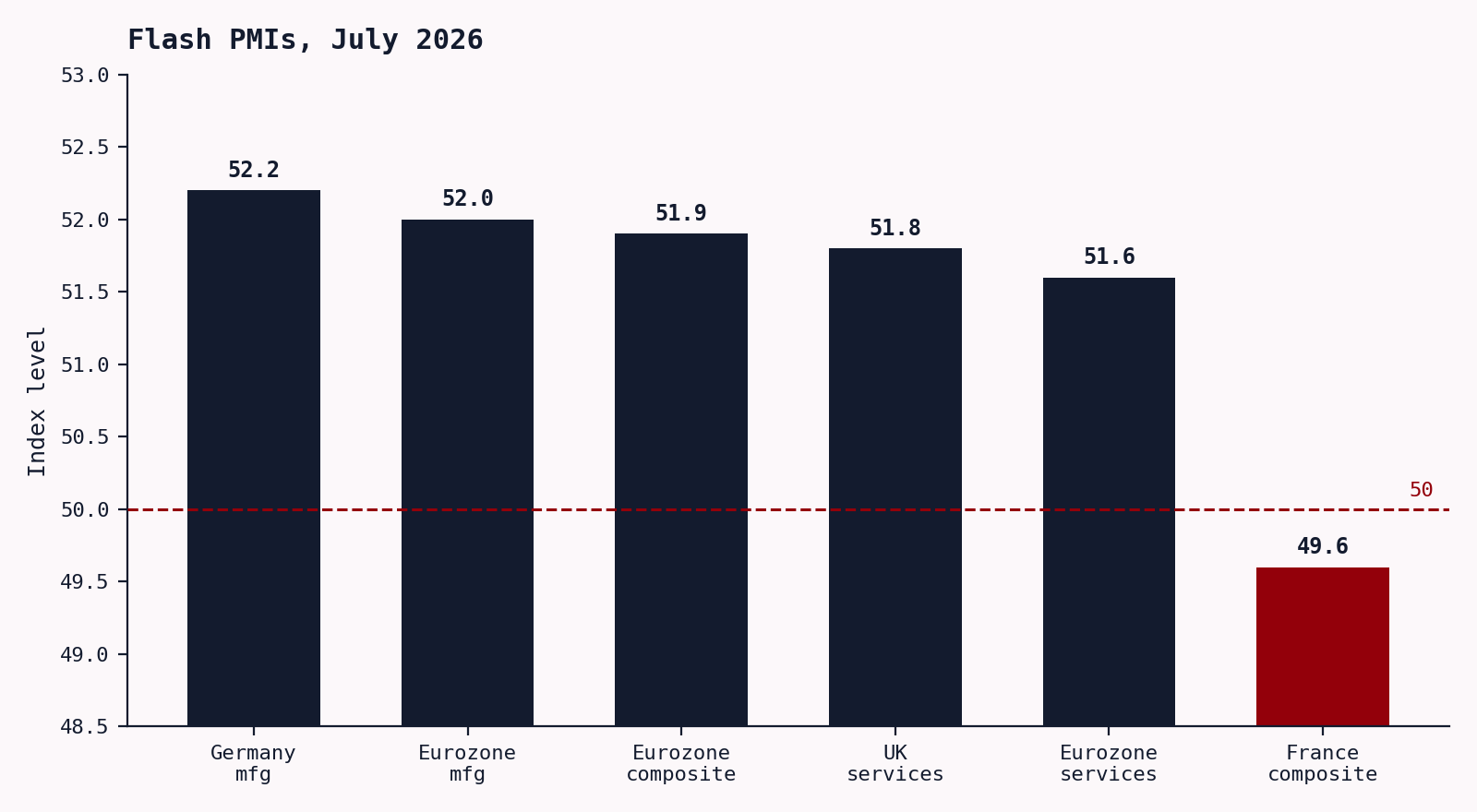
The July flash PMIs, out Friday, were the sort of surprise that makes economists reread the release. The eurozone composite jumped to 51.9 from 50.0, a five-month high, against a Reuters poll looking for 50.3. Services snapped three months of contraction at 51.6. German manufacturing hit 52.2, a four-year high. Even France, reliably the sick note of the survey, climbed to 49.6 from 47.2. S&P Global's chief business economist put the reading at roughly 0.3% quarterly GDP growth.
Now the other page of the same story. Dutch TTF gas futures pushed above €62 per megawatt-hour on July 22, around three-quarters higher than a year ago. EU storage is about 53% full against 64% a year ago, roughly fifteen points under the five-year norm and the lowest for late July in at least five years. Equinor, the bloc's largest supplier, has said the 80% target before the heating season looks unlikely. Wholesale power in most major European markets averaged above €110 per megawatt-hour. The ECB, meeting Thursday, left the deposit rate at 2.25% and watched.
The read: a PMI is a diffusion index. It asks firms whether this month is better than last month, and after a miserable spring the answer can be yes while the level stays poor. The energy bill, by contrast, is not a survey. It is a winter problem being priced in July, and a July that is already this expensive leaves the ECB holding a hike it made in June and a growth number it did not expect. Christine Lagarde's committee gets to find out which of those two data points was the signal.
3. The wedge nobody wants to talk about
June's inflation report was the week's inherited good news: headline CPI at 3.5%, down from 4.2%, with prices falling 0.4% on the month and core holding at 2.6%. Look one step up the chain and the picture changes. Producer prices rose 5.5% over the year to June, down from a 6.5% peak in May but still running far above what households are being charged, with core PPI at 4.7%. Roughly two percentage points separate what firms are paying from what they are collecting.
That gap resolves one of two ways, and both of them arrive later. Either companies pass the cost through, which puts consumer inflation back up sometime this autumn, or they eat it, which shows up in margins during exactly the earnings season now beginning. Futures markets have started to notice. Traders moved to price something close to a one-in-three chance of a rate rise at the July meeting, up from about 15% in the days after the CPI print, with September odds nearer 63%. The Fed meets Tuesday and Wednesday with its target range at 3.50% to 3.75%.
The read: core CPI at 2.6% is not a victory, it is a deferral. Someone in the supply chain is currently absorbing a cost that has not yet reached a shelf price, and the interesting question for the next two months is who. Watch gross margins in the consumer results, not the CPI headline.
4. An index of two stocks
The S&P 500 fell 0.6% on the week and the Nasdaq 2.1%, a second consecutive weekly loss for both. The Dow, down 0.4%, has now lost ground three weeks running. Almost all of it traces to two disappointing results: Alphabet and Tesla.
Which makes next week unusually loaded. Microsoft, Meta and Amazon report Wednesday and Thursday, with Apple and Qualcomm following. Four companies will move an index that a great many people hold precisely because they were told it was diversified.
The read: concentration is a wonderful thing on the way up and a governance problem on the way down. A week in which the broad American benchmark falls because two firms missed is not a market verdict on the economy, it is a market verdict on two firms. The distinction matters most in the weeks when it is easiest to ignore.
S&P Global flash PMIs, July 2026, 50 is the line between growth and contraction · Source: S&P Global via Reuters
Week of July 20 to 26, 2026
- $100.57
- Brent's Friday open, its first move through $100 in this conflict
- 51.9
- Eurozone composite PMI in July, a five-month high against a 50.3 consensus
- 53%
- EU gas storage, against about 64% at this point last year
- 5.5%
- US producer prices over the year to June, with consumer prices at 3.5%
- 7
- Vessels that changed course to avoid the Bab el-Mandeb
The week ahead
- The Fed, July 28 to 29: a committee that has spent the month insisting it is not done meets with oil back above $100 and a live minority pricing a hike. The press conference matters more than the decision.
- Big technology, Wednesday to Thursday: Microsoft, Meta and Amazon, then Apple. After Alphabet and Tesla dragged the index down, read the gross margin lines for evidence of who is absorbing the producer price wedge.
- Bank of England, July 30: a Monetary Policy Report alongside the rate decision, with June CPI at 2.6% and the Bank's own forecast pointing above 3% by the fourth quarter. Also worth watching: whether Red Sea reroutings spread beyond the seven vessels.
Selected sources
- CNN: Oil tops $100 a barrel, Houthi attack in Red Sea marks new escalation
- CNBC: Trump says US will hold Iran responsible for Houthi attacks after tankers targeted
- Fortune: Current price of oil as of July 24, 2026
- Reuters via Investing.com: Euro zone business activity returns to growth in July
- GMK Center: European gas prices rose above €60 per MWh in July
- CNBC: Consumer price index inflation report, June 2026
- CNBC: Wholesale inflation, June 2026
- CNBC: Stock market next week, outlook for July 27 to 31, 2026