The Referee Walks In
For a month the Fed argued about a forecast. This week the labour market printed minus 23,000 and ended the argument in a single line. Oil kept trading the rumour of a deal rather than the barrels, the Senate wrote a sanctions threat it has not yet sent, and equities read the whole week as permission to buy. Covering the week of August 3 to 9, 2026.
Two issues ago this publication watched six central bankers, three at the Fed and three at the Bank of England, vote to raise rates over an energy shock the oil market was busy marking down, and asked which side was actually making the forecast. On Friday the labour market answered. American employers cut 23,000 jobs in July, the first outright loss in years, against the eighty-odd thousand economists had penciled in. The three Fed officials who dissented for a hike a fortnight ago were arguing about the back half of a projection. The front half just arrived, and it points the other way.
1. Payrolls fall 23,000 and settle the family fight
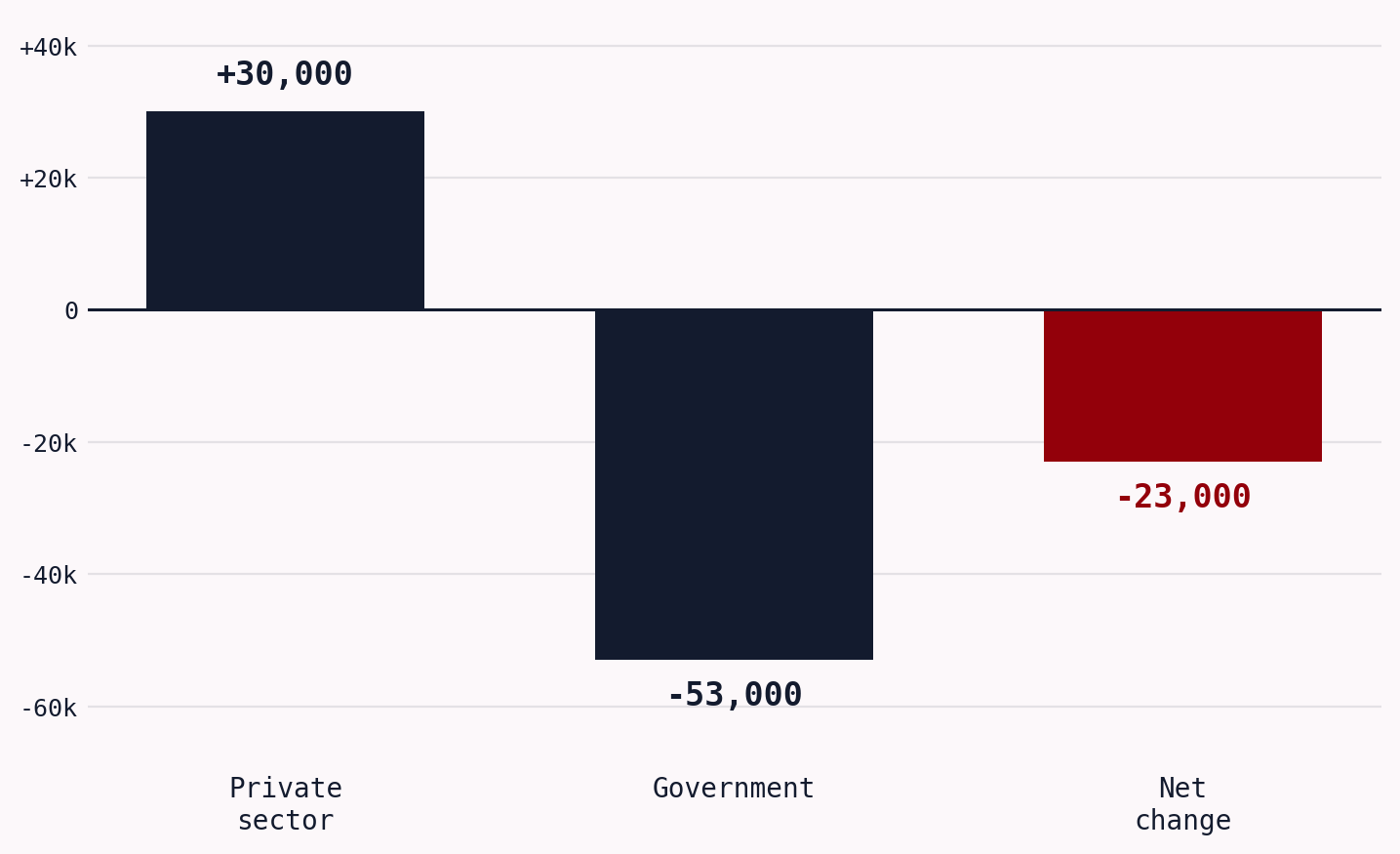
Kevin Warsh called his split committee "a good family fight" after the July meeting. This report is the referee walking in. Employers shed 23,000 jobs against expectations near 83,000, June was revised down to a 20,000 gain, and the twelve-month trend that had been running about 34,000 a month now looks generous. The unemployment rate fell to 4.1% from 4.2%, which sounds reassuring until you read how it got there: participation dropped to 61.4%, the lowest in more than five years, so the rate improved because people stopped looking, not because they found work. Wages carry the same signal. Average hourly earnings rose two cents, taking the annual pace to 3.2%, the softest since 2021.
Markets did the arithmetic in minutes. The odds of a September rate hike, a live bet while three officials were dissenting for one, fell to about 42%. The two-year yield dropped to 4.19%, its lowest since mid-July. And equities, which are supposed to flinch at a weakening economy, treated a shrinking payroll as a gift: the S&P 500 closed at a record 7,757.64 and booked its strongest week since April, with the Nasdaq up roughly 5%.
The read: a committee spent a month fighting over whether an oil shock would push inflation up enough to justify a hike. The labour market just told them the thing they were meant to be protecting is cracking on the other side. So what, exactly, were the three dissenters tightening into?
2. OPEC+ finishes a rollback the war already voided
On Sunday eight OPEC+ producers signed off on a 188,000 barrel a day increase for September, the sixth straight monthly rise, which completes the unwinding of the 1.65 million barrel cut the group agreed back in 2023. Then they drew a line under it: no further increases through the fourth quarter, leaving roughly two million barrels a day of older cuts in place. On paper it reads like a group confidently handing the market more oil and then stepping back to admire the balance.
The paper is the problem. The nominal barrels being added are dwarfed by the ones the war is quietly deleting. Damaged loading infrastructure, tankers that will not take the strait, precautionary shut-ins at Gulf terminals: analysts reckon actual Gulf output has fallen by several hundred thousand barrels a day, comfortably past the 188,000 the September headline promises. So the group is raising a quota it cannot physically fill and filing the result as a supply increase.
The read: OPEC+ has spent six months restoring barrels on a spreadsheet while the shooting war removes them from the water. The September hike is the last box ticked on the 2023 unwind, and it arrives as a number that changes almost nothing. When a cartel's output decisions stop moving its own output, who is the announcement even for?
3. The Senate passes the bill, and writes Iran into it
For three issues the argument here has been that the mispriced oil risk was the one arriving by legislation rather than by missile. On Thursday the Senate passed it, 86 to 11. The bill that cleared a procedural vote 86 to 12 a fortnight ago is now through the chamber in full, and it has picked up a name in transit: the Lindsey O. Graham Sanctioning Russia and Iran Act. Iran was written into a Russia sanctions bill somewhere between the two votes, which tells you how thoroughly the two oil wars have merged in Washington's head.
The mechanism is unchanged and still enormous. It authorises tariffs of up to 100% on the largest foreign buyers of Russian crude and gas, which means China and India, with carve-outs for countries that take little Russian gas and are cutting. It now needs the House and a presidential signature, and the president has said plainly that he wants it.
The read: a tariff wall around the buyers of the world's second largest crude exporter, with Iran now bolted on, is a supply event dressed as a trade measure, and it is one chamber away from a president who has endorsed it. The oil market spent the week trading a rumoured ceasefire and ignored this entirely. How much of that calm is a real read on barrels, and how much is a bet that Washington writes the threat and never mails it?
4. Oil pays 8% for a Wednesday that never came
Issue five called this "the price of a phone call", and the market spent the week proving the point almost to parody. On Tuesday Treasury Secretary Scott Bessent told CNBC that a deal to reopen the Strait of Hormuz with freedom of movement could come "as soon as Wednesday". Brent fell hard on the sentence, extending a slide that took it roughly 8% off its recent high to a three-week low near $79 by midweek. Wednesday came and went with no deal. Then Iranian state media published the draft plan itself, and the terms were narrow: a temporary Oman-brokered route with conditions attached, not a reopening. Crude climbed back to close near $83 on Friday, having round-tripped most of the week on a document nobody had signed.
None of this touched a barrel. No cargo loaded on the strength of Bessent's timetable, and none was blocked by the fine print that followed. The strait carried what it has carried for weeks, which is a fraction of its old traffic, and the price moved several dollars anyway on the question of whether a piece of paper would exist by Wednesday.
The read: for the second issue running, the world's most traded commodity moved further on a mediator's calendar than on the presence or absence of actual oil. The market is not pricing supply. It is pricing the odds of a handshake, and it will keep doing that right up to the morning the handshake turns out to have been a way of buying time.
US nonfarm payroll change by sector, July 2026 · Source: Bureau of Labor Statistics
Week of August 3 to 9, 2026
- 23,000
- US jobs lost in July, the first monthly payroll decline in years, against about 83,000 expected
- 42%
- Market-implied odds of a September Fed hike after the report, down from a live bet a fortnight ago
- 188,000
- Barrels per day OPEC+ adds in September, a sixth straight rise, before pausing for the fourth quarter
- 86 to 11
- Senate vote passing the Graham Russia and Iran sanctions bill, now on to the House
- 7,757.64
- The S&P 500's record close Friday, capping its strongest week since April
The week ahead
- US July CPI, mid-week: the inflation print lands on a committee that has just watched payrolls contract. It decides whether the energy pass-through the dissenters feared is actually showing up, or whether a cooling labour market is now the louder story.
- The House and the bill: whether the Graham Russia and Iran Act gets a floor vote before the recess, and how Beijing and New Delhi respond to a 100% tariff moving from threat toward statute. Legislation is the oil risk this market keeps refusing to price.
- Hormuz: whether the Oman-brokered route carries actual ships or stays a draft, and whether Iran's conditions hold. Transit counts remain the honest gauge, not the press releases around them.
Selected sources
- Bureau of Labor Statistics: The Employment Situation, July 2026
- CNBC: US economy unexpectedly lost 23,000 jobs in July
- CNBC: Odds the Fed hikes in September tumble following big July jobs miss
- CNBC: S&P 500 rises to record close and posts strongest week since April
- The National: OPEC+ agrees output rise in September but pauses increases from the fourth quarter
- Energy Connects: OPEC+ completes rollback of oil production cuts with September hike
- NPR: Senate passes Russia sanctions bill long championed by Lindsey Graham
- CNBC: Oil prices jump after Iran publishes restrictive draft plan for the Strait of Hormuz