Washington Crosses $40 Trillion and Bids for Its Own Bonds
Almost nothing happened to interest rates this week and almost everything happened to the borrower. The two year Treasury yield did not move a single basis point from Monday to Thursday, while the thirty year sat at its highest in nearly two decades, the federal debt passed $40 trillion, and the Treasury started buying its own long bonds back. Covering the week of August 17 to 23, 2026.
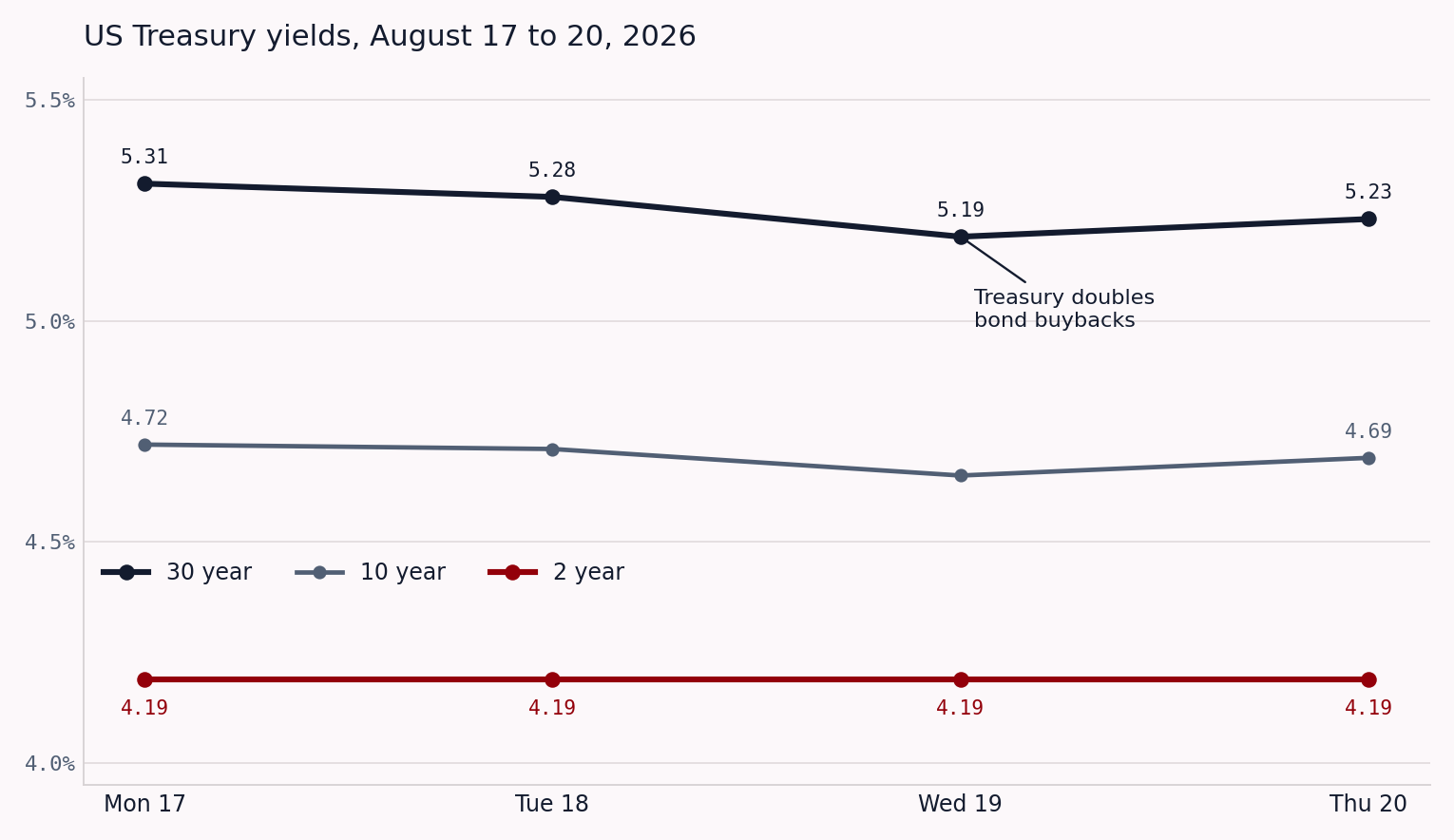
A week ago this publication argued that the Russell's record was a rate trade wearing a growth costume, and asked which half of it gets repriced first. The answer arrived from the end of the curve nobody in that trade was watching. Expectations for the Federal Reserve barely twitched: the two year yield printed 4.19% on Monday, 4.19% on Tuesday, 4.19% on Wednesday and 4.19% on Thursday, which is a market telling you it knows exactly what the next meeting holds. Everything beyond ten years moved, and it moved on a different question. Not what the Fed charges to lend, but what the United States has to pay to borrow.
1. The debt passes $40 trillion, five months after it passed $39 trillion
On Wednesday the Treasury's daily statement put federal debt above $40 trillion for the first time. It had crossed $39 trillion in March. A trillion dollars in five months is not a projection from a think tank with a view, it is a receipt. Washington now spends more than $1 trillion a year servicing that pile, more than it spends on defence, and interest costs in the first ten months of this fiscal year ran 15% above the same stretch of last year. The gap between what the government collects and what it spends has been north of $2 trillion for long enough that nobody bothers to call it an emergency.
The long end had spent the week making the point in advance. The thirty year Treasury yield opened Monday at 5.31%, a nineteen year high, with the twenty year at 5.30% behind it, and the thirty year fixed mortgage followed the pair to nearly 6.7%. Two years ago the argument against worrying about the debt was that the market kept buying it cheaply. The market has stopped agreeing to the second half of that sentence.
The read: the milestone itself is not the story, everyone could see it coming down the road. The speed is. A borrower whose interest bill has overtaken its army, whose deficit does not close in any published scenario, and whose longest paper now yields more than at any point since 2007 has stopped being a rates question and started being a credit one. How long can a government keep calling that a technical matter for the bond desk?
2. Bessent doubles the buybacks and the rally lasts two sessions
Wednesday was also the day the Treasury answered. Scott Bessent announced that buyback operations in longer dated debt would double in size, from roughly $2 billion to at least $4 billion apiece. That is a plumbing tool, designed to mop up old bonds nobody trades, and it was reached for at a distinctly unplumbing moment. It worked, briefly. The thirty year fell to 5.19% on the day from 5.28% on Tuesday. By Thursday it was 5.23%. By Friday's close it was 5.28% again, a complete round trip in three sessions, which is roughly how long the market needed to read the fine print.
The fine print is worth being precise about, because buyback is a word that sounds like repayment. Treasury purchases old, illiquid, off the run bonds and funds the purchases by issuing new ones, mostly at shorter maturities. Not one dollar of debt is retired. What changes is the shape of it: the government swaps money it owes in thirty years for money it owes in months. That is a duration trade, and every private borrower who has ever put one on did it for the same reason, because the long rate had become too expensive to pay.
The read: buybacks buy liquidity, and liquidity was not this week's problem. Supply was. The Treasury's response to a long yield it dislikes is to borrow shorter instead, which is elegant until the bills come round for rolling and the front end is the only part of the curve the Fed genuinely controls. Whose problem is that in 2027, the Treasury's or the Fed's?
3. Tokyo pays 1996 prices, Paris pays 2008 prices
None of this was American in any interesting sense. Japan's ten year touched 2.95% mid-week, a yield last seen in 1996, before settling near 2.88%. The local explanation is local: Sanae Takaichi's government wants to cut the consumption tax on food and has not said what pays for it, while Kazuo Ueda has allowed the market to believe the Bank of Japan could move again as soon as September. On Saturday this publication's France desk described the same week in euros, with the French ten year at 4.11%, its highest since October 2008, closing above Italy's, and the interest bill up 19%. Three governments, three domestic excuses, one trade.
Japan is also where the American story loops back on itself. Japanese institutions hold roughly $1.2 trillion of Treasuries, more than any other foreign owner. An insurer in Tokyo that can now earn 2.9% at home, in the currency it pays claims in, needs a much better argument to own a 4.7% American bond and pay to hedge it. For the first time in a generation the marginal foreign buyer of US government debt is being offered a decent deal without leaving home.
The read: if this were a Fed story the two year would have moved, and it did not. If it were a French story Tokyo would have sat still, and it did not. Strip out the national excuses and what is left is the thing all three have in common, which is that they are selling more paper than anyone particularly wants to own at these prices. Which of them finds that out at an auction first?
4. The minutes vote for a hike, Walmart says the customer is fine
Wednesday's third piece of news got the least attention and may age the worst. The minutes of the July meeting show the committee holding at 3.50% to 3.75% with three members, Beth Hammack, Neel Kashkari and Lorie Logan, voting instead for a quarter point increase, and participants judging that the pass through of past tariff increases into prices was "largely complete", leaving energy supply shocks as the live source of inflation. A week ago this publication suggested the disinflation on the screen might be the bad sort, the kind that arrives because customers stop showing up. The retailers spent this week arguing the opposite. Walmart's US comparable sales rose 2.6% excluding fuel, with ecommerce up 24%, revenue up 5.9% and operating income up 28.8%. Home Depot sold $47.9 billion of goods, up 5.7%, comparable sales up 1.7%, and reaffirmed its guidance for the year.
Which is worse news than it sounds, because a customer who is still spending is a customer costs can be passed to. Brent closed Friday at $95.29, against $88.52 the Friday before. Transits through Hormuz fell to 73 in the week to 16 August from 91 the week before, and the Gulf to China tanker route is paying north of $520,000 a day to move a cargo. Gold, the hedge that fell 22% into July and was written off as a broken fever, gained 5.9% in five sessions to trade near $4,630. It did not need an inflation print to do it. It needed a debt figure.
The read: the Fed cannot cut into $95 crude and a consumer who still turns up at the till, and it cannot hike into a borrower carrying $40 trillion whose long end is already on strike. Kevin Warsh takes the podium at Jackson Hole on Friday for the first time as chairman. Which of those two problems do you think he chooses to talk about, and which one will the thirty year be listening for?
US Treasury constant maturity yields, August 17 to 20, 2026 · Source: Federal Reserve H.15
Week of August 17 to 23, 2026
- $40tn
- US federal debt, passed on Wednesday, five months after it passed $39 trillion
- 4.19%
- The two year Treasury yield, unchanged Monday through Thursday while the thirty year opened the week at a nineteen year high
- 2.95%
- Japan's ten year yield at its mid-week peak, a level last seen in 1996
- $95.29
- Brent's Friday close, against $88.52 a week earlier, as Hormuz transits fell to 73 from 91
- 2.6%
- Walmart's US comparable sales growth excluding fuel, with ecommerce up 24%, against a July retail survey that had the consumer quitting
The week ahead
- Monday, the Iran package: Bessent holds a press conference on the sanctions he has been promising for a fortnight, alongside a blockade he describes as a "one-two punch". The measures that matter are the ones aimed at buyers and shippers rather than Tehran, so watch freight rates and transit counts rather than the podium.
- Wednesday, the inflation the Fed actually uses: core PCE is expected near 3.3%, arriving with the second reading of second quarter GDP and, the same day, Nvidia's results. One number tells you whether the July minutes were right to keep a hike on the table, the other tells you whether the equity market cares.
- Friday, Warsh at Jackson Hole: his first speech as chairman and his first public word since a meeting that produced three votes for a hike. A chairman inheriting a bond market that has stopped taking the long end on trust has a narrow path between sounding hawkish on inflation and sounding relaxed about $40 trillion.
Selected sources
- Federal Reserve: FOMC minutes, July 28 to 29, 2026
- Federal Reserve: H.15 selected interest rates, week of August 17, 2026
- NPR: The US debt tops a record shattering $40 trillion
- CNBC: Treasury doubles debt buybacks as Bessent moves to steady the bond market
- Walmart: second quarter FY27 results
- The Home Depot: second quarter fiscal 2026 results
- Lloyd's List Intelligence: Strait of Hormuz brief, 19 August 2026
- CNBC: Bessent on economic pressure, the blockade and Iran