Nvidia Guides to $108 Billion and the Fed Chair Calls It Inflation
For most of this AI cycle the equity story and the macro story have been told in separate rooms. This week they walked into the same one. The most valuable company on earth guided to $108 billion of quarterly revenue, and the new Fed chair used his first Jackson Hole to name the spending behind that number as a reason inflation is not coming down. Covering the week of August 24 to 30, 2026.
Two announcements set the week and they pointed the same way. On Wednesday Nvidia reported a quarter that would have been called impossible eighteen months ago and guided to a bigger one. On Friday Kevin Warsh stood up in Wyoming and said, in effect, that the boom on the one side is part of the problem on the other. By the close the market had moved September from a meeting where a cut was still whispered about to a coin flip on a rise. The AI trade did not break this week. It grew up, and acquired a macro consequence.
1. Warsh turns September into a coin flip
The Federal Reserve gathered at Jackson Hole with a new chair running his first symposium, and Warsh spent it narrowing the mandate rather than widening it. Inflation is running above the 2% target, he said, so the Fed's predominant focus right now should be on prices. The numbers behind the line are stubborn: the consumer price index sat at 3.4% over the year to July and the Fed's preferred gauge, core PCE, at 3.7%. He offered no roadmap and made a virtue of it, arguing that a quieter, more purposeful Fed communicates better by saying less.
The part worth marking is what he blamed. Warsh gave real time to artificial intelligence, not as the productivity miracle the equity market prices, but as an inflation driver, because the capital pouring into data centers is demand landing on a supply base that cannot flex fast enough. That is an unusual thing for a central banker to say out loud, and it rhymes with what the chip supply chain has been signalling for a month. Before he spoke the market priced roughly a one in three chance of a September increase. After him it was above even money.
The read: a Fed chair who names the biggest bull market of the decade as a source of the inflation he intends to fight has drawn a line the equity market has spent two years pretending was not there. If the boom and the mandate are now in tension, which one does a first-year chair choose to be remembered for?
2. Nvidia guides to $108 billion, and the memory bill goes to everyone else
The number that anchored the week arrived on Wednesday. Nvidia reported quarterly revenue of $96.2 billion, up 106% on a year earlier, with the data center line alone at $89.0 billion, up 117%, gross margin at 75%, and guidance for the current quarter of $108 billion. Jensen Huang added that the outlook assumes no data center compute revenue from China at all. The shares rose to a record and the company's value pushed further past $4 trillion. There was no demand problem anywhere in the release.
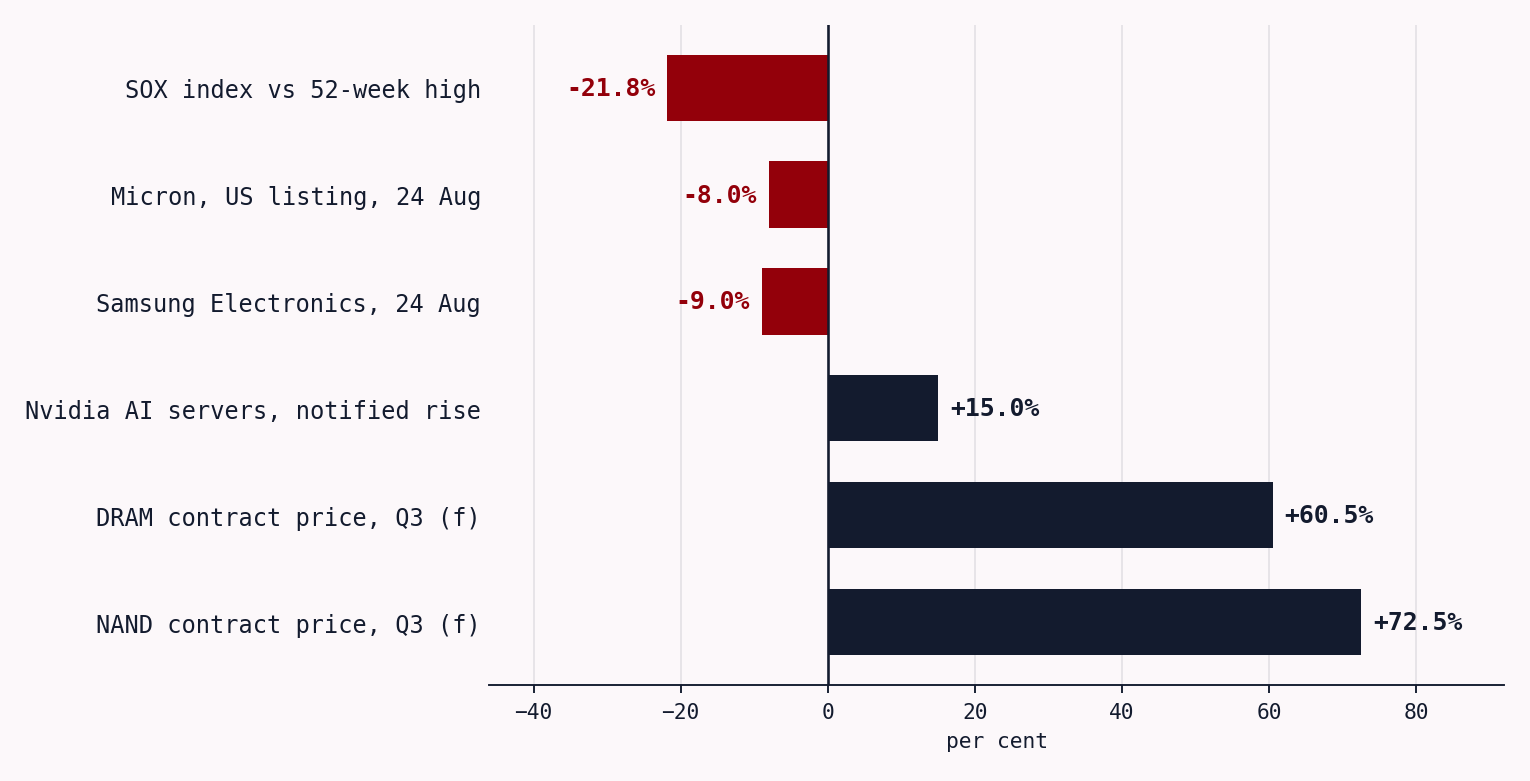
The cost problem is elsewhere, and it is now visible. Nvidia has told the firms that build servers for Microsoft, Google and Oracle that AI systems shipped from early next year will cost more than 15% more, and the reason is memory rather than silicon or margin: TrendForce expects DRAM contract prices up 58% to 63% this quarter and NAND up 70% to 75%, tight into 2027. Samsung, whose second quarter operating profit rose nineteenfold on that same memory demand, approved shareholder returns of up to about $80 billion, the largest in Korean corporate history, and the stock fell 9% while Micron and SK Hynix each shed more than 8%. Two weeks earlier Intel, which is not printing money, raised roughly $23 billion of equity to build capacity. The people closest to the cycle are handing cash back; the one that is behind is raising it.
The read: every capex figure the hyperscalers have guided to now buys 15% less hardware than it did when they guided to it, and a cost that size does not stay inside a data center. It lands on their returns or on the price of what the models sell, which is the exact channel Warsh pointed at from the other end. When the seller reports a record and the memory makers get sold off in the same session, which side of the trade is the market marking down?
3. Bessent calls it D-Day, and the oil kept moving
On Monday the Treasury launched Operation Economic Outcast, designating close to 60 entities, individuals and vessels tied to Iranian procurement, cyber operations and the shadow fleet moving its crude, and Scott Bessent called it an economic D-Day, the single greatest financial offensive ever marshalled against an adversary. Alongside the designations came five sectoral determinations that make whole fields, digital assets, technology, gold, aviation and shipping, sanctionable in their own right. Brent lost 2.5% to $92.06 and WTI fell to $84.89.
Prices fell on the biggest sanctions package of the war for two reasons in the fine print. The campaign is a schedule, not a strike: governments are being given time to wind down Iran-related business before the secondary sanctions bite, and the opening round left the major banks of the country that actually buys the oil untouched. And the barrels are still moving. US Central Command said in the same week that it had aided the passage of roughly 660 million barrels of oil through the Strait of Hormuz since May, escorting traffic through a corridor along the Omani coast. The blockade that was meant to be Iran's leverage is being routed around, and the sanctions that were meant to be Washington's arrive with a grace period attached.
The read: both sides announced maximum pressure this month and both are now running a timetable. If the buyers of Iranian crude are being telephoned and asked to wind down at their own pace, who is the D-Day actually for?
4. The oil war nobody repriced
While the market spent Monday reacting to a press conference about Iranian crude, it left the other oil war exactly where it found it. Russian refineries processed roughly 3.6 million barrels a day in July, the lowest since May 2002 and about a third below the seasonal norm, after a drone campaign that has now reached every one of the country's largest plants. Diesel and gasoil exports in the first week of August ran near 80,000 barrels a day. Last year Russia shipped as much as a million. More strikes landed through late August, in Ryazan, Volgograd and Krasnodar.
In July this publication argued that two threats to oil supply were escalating at once and only one of them carried a risk premium, then asked which was mispriced. Six weeks on the answer is uncomfortable, because crude is not the tight barrel. Middle distillate is, and middle distillate is what moves freight, farming and heating. A sanctions headline about Iranian crude repriced the barrel that is not scarce and ignored the collapse in the one that is.
The read: a market that trades the headline about the barrel while ignoring the arithmetic on the refined product is not mispricing a war, it is mispricing a season. What does European diesel cost in January if Russian runs are still sitting at 2002 levels?
Memory contract price forecasts for the third quarter of 2026 and Nvidia’s notified server increase, against selected equity moves the same week · Sources: TrendForce, Bloomberg, Nasdaq
Week of August 24 to 30, 2026
- $96.2bn
- Nvidia’s quarterly revenue, up 106% on the year, with guidance for the current quarter set at $108 billion
- 3.7%
- Core PCE, the Fed’s preferred inflation gauge, and the number behind Warsh’s focus on prices
- above 50%
- Odds of a September rate rise after Jackson Hole, up from roughly one in three before Warsh spoke
- $92.06
- Brent’s close on the day Washington called its Iran campaign an economic D-Day, down 2.5%
- 80,000
- Barrels a day of Russian diesel and gasoil exports in early August, against as much as a million a day last year
The week ahead
- Early in the week, euro area inflation: Eurostat publishes its August flash estimate, into an ECB that has already said it would raise rates even if an energy driven spike proved short lived. Diesel is the component of that spike no central bank controls, and Russian runs at a 24 year low are the reason it is tight.
- Friday, September 4, August payrolls: the last full labour reading before the FOMC meets on September 15 to 16, and it now matters in the other direction. After Warsh, a hot number does not just cancel a cut, it feeds a live case for a rise.
- Early September, OPEC+: the group meets having finished unwinding its 1.65 million barrel voluntary cut, with delegates signalling quotas hold for the rest of the year. A cartel that sells crude has no obvious answer for a world short of the refined product instead.
Selected sources
- NVIDIA: financial results for the second quarter of fiscal 2027
- NPR: Fed chair Warsh warns inflation is too high at Jackson Hole
- CNBC: September Fed decision is now a coin flip as rate-hike odds increase
- Bloomberg: Nvidia customers notified about AI-related price hikes above 15%
- CNBC: Samsung plans up to $80 billion in shareholder returns
- US Department of State: Operation Economic Outcast fact sheet, 24 August 2026
- CNBC: US military says it aided passage of 660 million barrels through Hormuz since May
- Bloomberg: Russian diesel flows are the lowest in years as drones hit refiners