The US Strikes Iran's Tankers and Inflation Reaccelerates
Inflation came back this week on both sides of the Atlantic, and the fine print says why. The jump is energy, and the energy is a war. The US and Iran turned the Strait of Hormuz kinetic again, OPEC+ stopped adding barrels, and a hot US jobs report and a 3.3% euro print handed two central banks the case for hiking into a supply shock they cannot fix. Covering the week of August 31 to September 6, 2026.
Last week this publication asked who an economic D-Day was actually for, while barrels moved quietly through a US-protected corridor and the sanctions arrived with a grace period. This week the Strait answered. The corridor became a battlefield, the barrels stopped, and the inflation the Fed spent Jackson Hole worrying about showed up in the data three days later. The two stories that looked separate a week ago, a shooting war in the Gulf and a central bank leaning hawkish, turned out to be the same story read from two ends.
1. The Strait goes kinetic, and the barrels stop
The month of relative calm ended on Tuesday. The US struck roughly 100 targets inside Iran, air defenses, radar and missile launchers, along with two Iranian government tankers hit in their engine rooms, after Iranian attacks on commercial ships in Hormuz and on American bases in the region. Iran answered with about 25 ballistic missiles and two dozen drones aimed at bases in Bahrain, Kuwait and Erbil, most of them intercepted. By Friday the US had disabled three more Iranian tankers, near Kharg Island, off Jask and in the Gulf of Oman, two left permanently out of service. Iran targeted US Navy warships, which evaded without American casualties. At least five people were reported killed in the earlier bombardment of southern Iran.
The market reads this through one number, and it is not a casualty count. Traffic through the Strait, which normally carries about a fifth of the world's seaborne oil, has stayed low, and Brent is back near $96 a barrel after spending late August drifting toward $92. The strait that issue nine described as quietly open, its barrels escorted along the Omani coast, is closed enough again that the price has round-tripped its entire post-sanctions decline in a week.
The read: the grace period was real and it is over. Both sides spent August announcing timetables and this week ran out of them. If the corridor only worked while nobody was shooting at it, then the premium the oil market took out in August was never a peace dividend. It was a bet on restraint, and restraint is the one supply that ran out first.
2. OPEC+ stops adding barrels into a war
On Sunday the eight OPEC+ producers that spent six straight months raising output decided, for October, to do nothing. The group had just finished unwinding the full 1.65 million barrels a day of voluntary cuts it announced in 2023, restoring them in monthly steps through the summer. October is the first month in half a year with no increase, and the stated reason is the uncertainty in the Gulf. Brent sat at roughly $96 and WTI near $82 as they met.
A week ago this publication noted that a cartel which sells crude had no obvious answer for a world short of the refined product, and wondered what it would do. The answer is that it chose to hold rather than pour barrels into a war it cannot price. That is not generosity to prices, it is caution: adding supply you may not be able to ship, into a strait your own members depend on, is a way to look reckless in both directions at once.
The read: the group that spent 2026 proving it would defend market share by flooding the market has, for one month, blinked. The question is whether October's pause is a one-off gesture to the conflict or the moment the unwind quietly stops. Which of those the market believes will show up in the shape of the forward curve long before it shows up in a communique.
3. Payrolls run triple the forecast and hand the Fed its excuse
The August employment report on Friday was the number Warsh needed and the composition he did not. Payrolls rose 162,000 against a consensus near 55,000, close to triple the forecast, while the unemployment rate sat at 4.1%, its highest since 2021. The two year Treasury yield rose to 4.37%, its highest since January 2025, the thirty year held above 5.2%, and equities gave back ground as the market moved a September increase back to roughly a coin flip. A week after the Fed chair named prices as the priority, the labor data refused to give him cover for patience.
The tell is in holding those two facts together. A headline that beats by more than 100,000 says the economy is not slowing the way a soft July suggested; an unemployment rate at a four year high says the slack is building somewhere the headline does not show. That is a labor market cooling and reheating at once, which is exactly the reading a committee arguing about inflation rather than employment will resolve in favor of the hawks. The CPI and PPI prints due this week now carry the whole decision.
The read: the case for a September hike no longer rests on inflation alone, it rests on a jobs number strong enough to say the economy can take one. But a hot payroll into a rising unemployment rate is a strange thing to tighten against. Is the Fed about to raise rates because the economy is strong, or because it cannot afford to look like it blinked on prices?
4. Europe gets the number it was warned about, so read the core
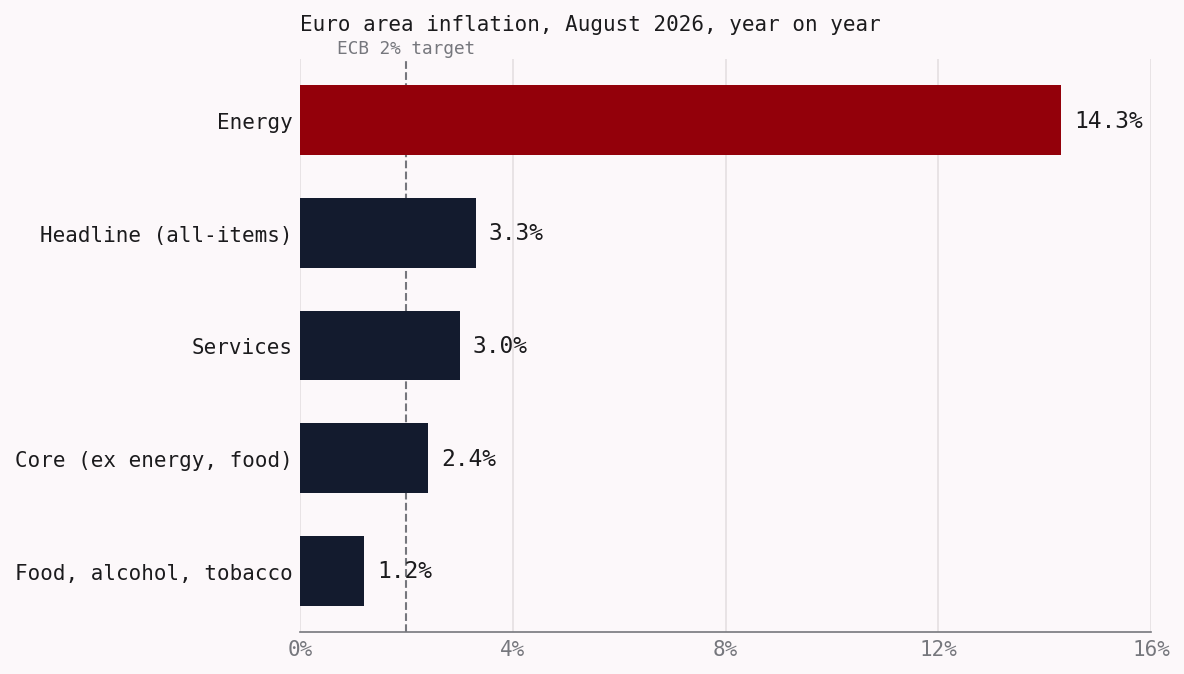
Euro area inflation jumped to 3.3% in August from 2.9% in July, comfortably above the ECB's 2% target and the first real upside surprise in months. Almost all of it is energy, which rose 14.3% over the year against 10.3% a month earlier, the direct print of the same Hormuz disruption moving oil and gas. The number underneath tells the opposite story: core inflation, stripping out energy and food, fell to 2.4% from 2.5%, and services, the gauge the ECB watches most closely, eased to 3.0% from 3.3%. The heat is entirely in the barrel.
Last week this publication argued that diesel was the component of any energy spike no central bank controls, and that Russian refinery runs at a 24 year low were the reason it was tight. Add a shooting war in the Strait and the spike arrives on schedule. The ECB is nonetheless expected to raise a quarter point at its meeting on Wednesday, which puts Frankfurt in the same box as Washington: tightening into an inflation number whose engine is a supply shock a rate rise does nothing to reach.
The read: when headline inflation is climbing on energy while core is falling, a rate rise treats the symptom the central bank can see and misses the cause it cannot. Both the Fed and the ECB are about to raise into a war premium. Does a higher policy rate move a single barrel through Hormuz?
Euro area August 2026 flash inflation by component, year on year · Sources: Eurostat, ECB
Week of August 31 to September 6, 2026
- 162,000
- US payrolls added in August, close to triple the 55,000 expected, even as unemployment held at 4.1%, its highest since 2021
- 3.3%
- Euro area inflation in August, up from 2.9%, as energy rose 14.3% while core inflation fell to 2.4%
- 4.37%
- The two year Treasury yield after the jobs report, its highest since January 2025
- $96
- Brent a barrel as the US and Iran traded strikes, back from about $92 a week earlier
- 0
- OPEC+ output increase scheduled for October, after six monthly rises in a row
The week ahead
- Wednesday, September 10, the ECB: a quarter point rise is expected, into a 3.3% print whose engine is energy and whose core is easing. Watch whether the statement treats the spike as temporary or as something to lean against, because the two readings point at very different autumns.
- Around mid week, US CPI and PPI: the last inflation reads before the FOMC, and after a hot payroll they now carry the September decision on their own. A firm core would make a hold hard to defend.
- September 15 to 16, the FOMC, and the Strait: the meeting sits on a knife edge at roughly even odds, and the bigger variable is not on the calendar. Whether the Hormuz fighting holds, cools or widens will move the oil price the Fed has to forecast against.
Selected sources
- Axios: US strikes Iranian oil tankers for the first time in retaliation for Hormuz strikes
- NPR: US and Iran trade attacks on ships as fighting flares again
- CNN: US military strikes three Iranian tankers in retaliation for missile attacks
- CNBC: OPEC+ keeps oil output policy unchanged for October
- US Bureau of Labor Statistics: the Employment Situation, August 2026
- CNBC: two year yield rises to highest since January 2025 after hot jobs report
- Eurostat: euro area annual inflation up to 3.3%, August 2026 flash
- TheStreet: yields jump and stocks fall after the jobs report surprises to the upside