The ECB Hikes to 2.50% and the Fed Runs Out of Room
This week the central banks stopped debating and started moving. The ECB raised to 2.50% and called it a no brainer, US inflation held at 3.4% on the same energy the war keeps bidding up, Brent jumped about 9%, and Oracle booked a $664 billion AI backlog, the very spending a Fed chair blamed for inflation three weeks ago. Every read pointed one way, into the meeting the Fed holds next. Covering the week of September 7 to 13, 2026.
A month ago the argument was whether inflation would come back. A fortnight ago it did, and the case was that the heat was energy and the energy was a war. This week the argument moved on again, from whether to how much. The first central bank to answer raised rates and did not pretend the decision was hard. The next one meets on Wednesday of the coming week with an inflation print that gave it no cover and an oil price that keeps climbing. The question is no longer whether policy tightens into a supply shock. It is how far it goes, and what breaks when it does.
1. The ECB moves first, and Lagarde calls it a no brainer
On Wednesday the European Central Bank raised its deposit rate to 2.50%, the second increase since the Iran war began, and Christine Lagarde spent the press conference removing the ambiguity rather than adding it. She called the decision a no brainer, the bank lifted its inflation forecasts, and markets left the meeting pricing more to come rather than a pause. This is the same institution that spent the first half of the decade explaining why it could look through energy spikes. It has stopped looking through this one.
Last week this publication argued that Frankfurt was in the same box as Washington, tightening into an inflation number whose engine is a supply shock a rate rise cannot reach. Frankfurt has now moved first, and the honesty of the framing matters. A central banker who calls a hike into a war a no brainer is not claiming the rate will move a barrel. She is claiming that a headline above target for long enough becomes an expectations problem whatever its cause, and that the cost of being seen to tolerate it is higher than the cost of tightening into weakness.
The read: the ECB has decided that credibility is the variable it can still control when the oil price is not. That is a defensible call and an expensive one, because the eurozone economy was not strong going into this. If the war premium fades on its own, Frankfurt will have tightened into a slowdown for a spike that was leaving anyway. Is that caution, or is it fighting the last war with the last decade's instrument?
2. US inflation holds at 3.4%, and the Fed's room runs out
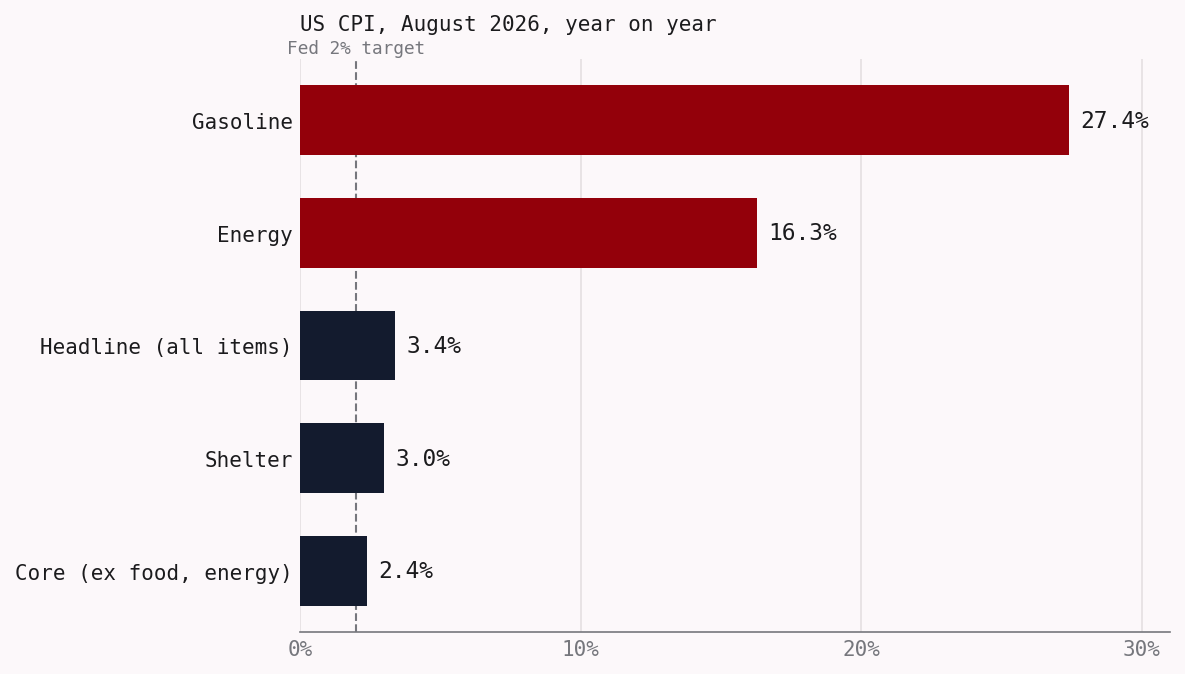
Thursday's August CPI gave the Fed no way out. Prices rose 0.4% on the month and held at 3.4% over the year, with core up 0.3% and 2.4%. The split is by now familiar: energy did the work, gasoline rising 3.9% in the month and 27.4% over the year, more than a third of the monthly increase in one line, while core stayed contained. It is the American print of the European story, a headline pushed by the barrel and an underlying rate that has not run away. The market read it in one direction anyway, and bets on a rate rise at the coming meeting jumped.
Three weeks ago a Fed chair used Jackson Hole to put prices first and name the AI build out as an inflation driver. Two weeks ago a jobs report came in at triple the forecast. This week the last inflation reading before the decision refused to soften. The committee that meets on Tuesday and Wednesday now has a hot labour market, an above target headline and a peer central bank that just moved, and very little left to hide behind if it wants to hold.
The read: the same objection applies on this side of the Atlantic. A rate rise does not refine a barrel of diesel or reopen a strait, and core inflation at 2.4% is not the picture of an economy overheating from within. The Fed is being pushed toward tightening against a price it does not set. Is it about to raise because demand is too hot, or because an energy headline has made holding look like surrender?
3. Brent jumps to $105, and the war keeps the bid
The barrel behind both prints did not sit still. Brent rose about 9% on the week to around $105, its climb resuming as the Strait of Hormuz stayed contested and the Houthis pushed toward the Bab al-Mandeb at the other end of the Red Sea, threatening the second chokepoint while the first is still fought over. Diplomacy is stirring, with Gulf foreign ministers due to meet their Iranian counterpart in Oman to discuss a temporary arrangement for shipping, and that prospect trimmed Friday's gains. The International Energy Agency, meanwhile, cut its demand outlook for the year, a reminder that the same price is being pulled up by war and down by a slowing economy.
This is the part the two inflation prints depend on and neither central bank controls. The energy line in the CPI and the 14.3% energy jump in the euro figures are this price, translated into the cost of living with a lag. If the Oman talks produce a shipping corridor that holds, the war premium drains and the inflation both banks are tightening against starts to fade on its own. If they do not, the barrel keeps climbing into a winter of European heating demand.
The read: the oil market is pricing two opposite futures at once, a supply shock that widens and a demand slump that deepens, which is why it can jump 9% in a week and still look cheap or dear depending on the day. The central banks do not have that luxury. They have to pick a path on Wednesday and Thursday and live with whichever future arrives. Which one are they forecasting?
4. Oracle's $664bn backlog says the boom the Fed blamed is still growing
On Wednesday Oracle reported the number that made the AI trade forget the rate scare for a day. Its backlog of contracted, not yet delivered cloud revenue reached $664 billion, after more than $30 billion of new AI contracts signed in the quarter, and the stock jumped 7% to $164.25. Revenue set a record at $19.3 billion, cloud infrastructure grew 121% over the year, and the company said it had delivered more than 300,000 GPUs and 850 megawatts of data centre capacity, demand still running ahead of supply. CoreWeave and Nebius rose with it.
Set that beside the week's other news and the awkwardness is the point. The Fed chair named the capital pouring into data centres as a reason inflation will not fall, because it is demand landing on a supply base that cannot flex. This week that demand booked another $664 billion of orders. The boom that is helping to keep prices up is not slowing as rates rise toward it, it is accelerating, funded by prepayment and balance sheets deep enough not to care what the two year yield does.
The read: a rate rise is supposed to cool demand, but the loudest demand in the economy is being placed by firms that do not borrow at the policy rate to place it. If the AI build out is both a driver of the inflation and immune to the medicine, the Fed is tightening onto the part of the economy that will feel it, the mortgage and the small business, while the part it partly blames sails on. Who actually pays for the hike?
US CPI components, August 2026, year on year · Sources: US Bureau of Labor Statistics
Week of September 7 to 13, 2026
- 2.50%
- The ECB’s deposit rate after a second hike since the war, a decision Lagarde called a no brainer
- 3.4%
- US headline inflation in August, holding as core sat at 2.4% and gasoline rose 27.4% over the year
- $105
- Brent a barrel, up about 9% on the week as the Hormuz war ground on
- $664bn
- Oracle’s contracted AI cloud backlog, the build out a Fed chair named as an inflation driver
- 16.3%
- The year’s rise in the US energy index, the war showing up in the cost of living
The week ahead
- September 15 to 16, the FOMC: the decision the whole week pointed at. After a hawkish Jackson Hole, a jobs report at triple the forecast and a CPI that held at 3.4%, a rate rise is a live outcome for the first time in years. The dot plot and the press conference will matter more than the move.
- The Strait, and the Oman talks: whether the Gulf and Iranian foreign ministers produce a shipping arrangement that holds, or the war premium stays in the oil price the central banks are forecasting against.
- Other central banks: with the ECB moved and the Fed on the clock, watch whether the Bank of England and others follow the turn or hold, and whether any of them dares to name the same supply shock as the reason.
Selected sources
- Bloomberg: Lagarde calls ECB hike a no brainer as markets bet on more
- US Bureau of Labor Statistics: Consumer Price Index, August 2026
- CNBC: August CPI report and what it means for the Fed
- Reuters: Oracle shares rise as AI cloud backlog beats estimates
- Yahoo Finance: stocks end a losing week higher as Fed rate-hike bets jump
- The Hill: the Strait of Hormuz conflict drives up oil prices and uncertainty
- International Energy Agency: Oil Market Report, September 2026