The Fed Hikes to 4% and the Ten Year Hits 5%
The meeting the last month pointed at arrived, and the Fed did the thing it had not done since 2023. It raised rates, unanimously, and told the country inflation had been too high for too long. The bond market answered by sending the ten year toward 5%. The Bank of England looked at the same world and refused to move. The oil behind all of it hit a four-month high. Covering the week of September 14 to 20, 2026.
For four issues this has been a story about a direction. A Fed chair naming prices as the priority, a jobs report too hot to ignore, an inflation print stuck on energy, an ECB that moved first. This week it became a story about a level. The Fed raised, the number is now a four handle, and the argument turns from whether policy tightens into a supply shock to how long it can before something gives. Two other central banks answered the same question the same week and did not all say yes, which is the first crack in what had looked like a consensus.
1. The Fed hikes for the first time since 2023
On Wednesday the Federal Reserve raised the federal funds target to a range of 3.75% to 4%, a quarter point, its first increase since July 2023, and the vote was unanimous at 12 to 0. Kevin Warsh used the press conference to say what he had been circling since Jackson Hole, that inflation is too high and has been for too long, while calling the labour market, with unemployment near 4.1%, in good shape. The projections carried the real message: the median policymaker pencilled in one more quarter point before the year is out and a funds rate holding near 4% through 2027, with PCE inflation still seen at 3.6%.
Three weeks ago this publication asked whether the Fed would raise because the economy was strong or because it could not afford to look like it had blinked on prices. The answer, in Warsh's own framing, is the second dressed as the first. He leaned on a solid labour market to justify the move, but the reason he gave was the price level, not overheating demand. A 12 to 0 vote is the tell. A committee that was split three ways in July closed ranks the moment the chair made credibility the question, because no individual member wants to be the name attached to tolerating a four handle on inflation.
The read: the Fed has chosen the same trade the ECB chose a week earlier, spending growth to defend the idea that it still controls prices. It is a defensible bet and a one-way one, because if the energy spike fades the hike was into weakness, and if it does not a single quarter point will not have touched it. Which of those is Warsh actually forecasting, and does the dot plot's second hike mean he does not know either?
2. The bond market hears "higher for longer" and takes it further
The reaction was not in equities, where the S&P slipped about half a percent and the Dow fell more than 600 points on the day, but in the thing that actually sets the cost of money. The ten year Treasury yield pushed toward 5%, its highest since 2023, and the move kept going after the meeting: the Dow closed out its worst week since March as yields climbed. Futures now price better than even odds of another hike by October. The market did not just accept the Fed's signal, it extended it.
This is the part that matters more than the quarter point. The Fed sets an overnight rate; the ten year sets mortgages, corporate borrowing and the discount rate under every equity valuation, and it is now doing the tightening the Fed only gestured at. A long yield near 5% with core inflation at 2.4% is a real rate high enough to slow things that a 3.75% floor on overnight money does not reach on its own. The bond market has decided the Fed is behind and is closing the gap for it.
The read: a central bank that hikes 25 basis points and watches the ten year jump toward 5% has been handed both a gift and a warning. The gift is that financial conditions tightened more than it dared to. The warning is that it no longer fully controls the pace, and a disorderly long end is how a rate cycle stops being about inflation and starts being about something breaking. What breaks first at a 5% ten year?
3. The Bank of England looks at the same world and says no
A day after the Fed, the Bank of England held its rate at 3.75%, and the split told the story: six to three, with three members voting to hike now. UK inflation had just climbed to 3.1%, a five month high, so the dissenters were not inventing a threat. The majority looked at an economy visibly weaker than America's and decided that raising into that weakness, for an energy shock a rate cannot fix, was the greater risk. Governor and committee effectively defied the lead the Fed and the ECB had set.
This is the first divergence in the story, and it is the honest one. Every argument this publication has made about the futility of tightening into a supply shock is the argument the BoE majority just made out loud. They are not denying inflation is above target, they are saying the cause sits outside their reach and the cost of chasing it is a recession they would own. The three dissenters are making the ECB's case, that credibility above target for too long becomes its own problem. Same data, same war, opposite conclusion.
The read: the three central banks have now split into hike, hike and hold, which means the consensus that energy inflation forces everyone's hand was never really a consensus, it was a choice about which risk each bank feared more. The BoE is betting the spike fades before expectations unmoor. The Fed is betting it cannot afford to find out. In a year we will know which one was managing the economy and which one was managing its own reputation. Which bet would you rather own?
4. The oil behind all of it hits a four-month high
The supply shock the whole argument rests on did not cooperate with anyone's forecast. Brent touched about $106 a barrel on Tuesday, a four-month high, before easing toward $103, up for a third straight week. The talks that were supposed to calm the Strait, the on-and-off dialogue between Tehran, Washington and the Gulf states hosted in Oman, produced no arrangement to restore shipping, and the president floated re-escalating strikes rather than waiting. Saudi and Houthi forces traded fire across the Yemeni border. The war that put the energy line in every inflation print is not fading, it is broadening.
Hold that next to the week's decisions. Two central banks tightened, and a third was pressed to, against a price that spent the same week making new highs and giving no sign of a peak. If the barrel keeps climbing into winter, the energy pass-through that pushed euro area inflation to 3.3% and kept the US at 3.4% has further to run, and the hike the Fed just delivered plus the one it has pencilled in will not have addressed the cause of either. The rate rises are aimed at the second-round effects. The first round is a shooting war at a chokepoint.
The read: the uncomfortable possibility under this whole cycle is that the single most important variable for inflation is not a policy rate on either side of the Atlantic, it is whether ships move through a 21-mile strait. Central banks can shape what a spike does to expectations. They cannot reopen a waterway. So who is really setting monetary policy this autumn, the committees, or the fleet in the Gulf?
Main policy rate after each bank’s September decision, the Fed shown at the top of its target range · Sources: Federal Reserve, Bank of England, ECB
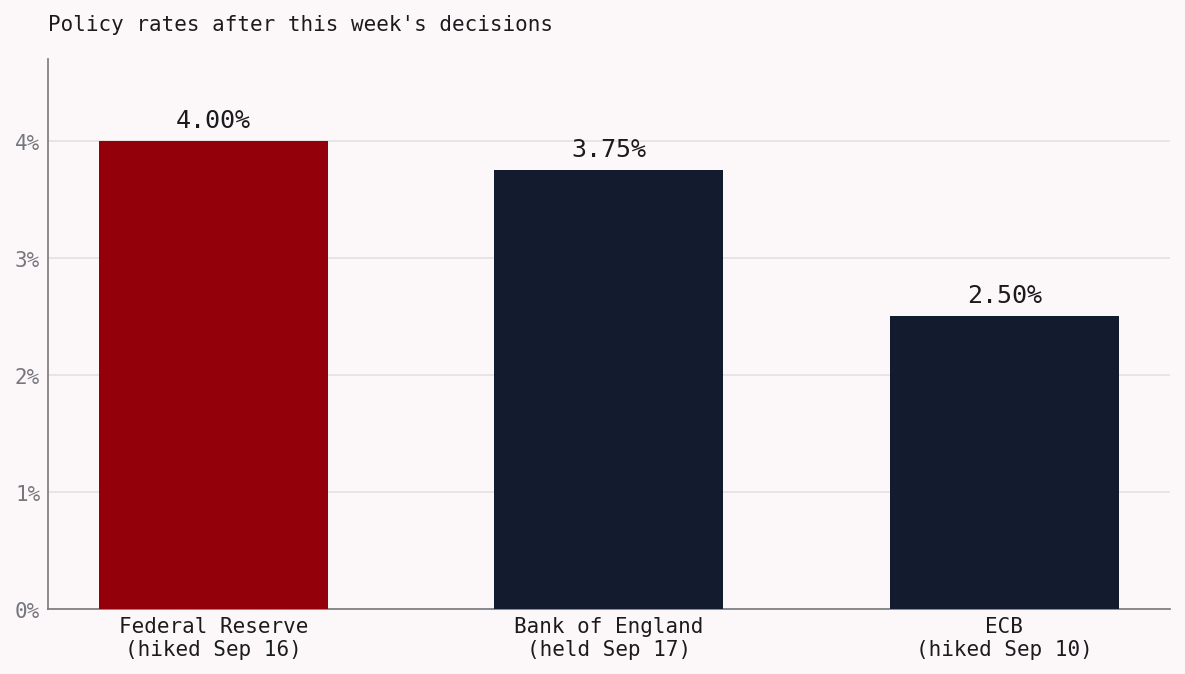
Week of September 14 to 20, 2026
- 3.75% to 4%
- The new federal funds target after the Fed’s first hike since 2023, a unanimous 12 to 0 vote
- ~5%
- The ten year Treasury yield after the meeting, its highest since 2023, as the Dow logged its worst week since March
- 6 to 3
- The Bank of England vote to hold at 3.75%, with three members wanting a hike as UK inflation hit 3.1%
- $106
- Brent’s four-month high on Tuesday, up for a third week as the Oman talks failed to restore Hormuz shipping
- 3.6%
- The Fed’s own projection for PCE inflation, still well above its 2% target
The week ahead
- The long end of the Treasury market: with the ten year near 5%, watch whether the move stays orderly or starts to feed on itself. A jump in term premium, a soft auction, or a wobble in a rate-sensitive corner would be the first sign the tightening has passed from policy to accident.
- PCE inflation, the Fed’s preferred gauge: the August reading lands late in the week against the Fed’s own 3.6% projection. A hotter number validates the pencilled-in second hike; a softer one reopens the question of whether the first was necessary.
- The Strait, and the risk of re-escalation: with the Oman talks stalled and the president weighing fresh strikes, the oil price that drives every inflation print is the variable no central bank on the calendar controls.
Selected sources
- CNBC: Fed raises rates to 3.75% to 4%, its first hike since 2023
- Fox Business: Federal Reserve hikes for the first time since 2023, dot plot and projections
- CNBC: Dow posts worst week since March as Treasury yields rise
- CNBC: Bank of England defies the Fed’s lead and leaves rates unchanged
- Euronews: Bank of England holds at 3.75% in a 6-3 split as inflation hits a five-month high
- Bank of England: September 2026 Monetary Policy Summary and Minutes
- Reuters: Brent hits a four-month high as Strait of Hormuz talks stall