The Market That Refused to Panic
The scenario markets said they feared arrived on schedule, and equities shrugged. Covering the week of July 6 to 12, 2026.
Last week this publication argued that with peace fully priced, the risk in oil was asymmetric: a deal would add little, a breakdown would reprice everything. The breakdown duly arrived. Ships burned in the Strait of Hormuz, the US and Iran traded strikes, and Brent climbed about 5%. And yet stocks ended the week close to where they began, and the repricing was smaller than the rhetoric. The interesting question is why, and the answer has a lot to do with spare barrels.
1. The ceasefire buckles, the market does not
From Monday into Tuesday, three commercial vessels were struck in and around the Strait of Hormuz, including the Qatari LNG carrier Al Rekayyat, which caught fire off the Omani coast. US officials said Iran's Revolutionary Guard fired at least two missiles at commercial shipping; Iranian state media implied the Qatari tanker had ignored "repeated warnings", a pointed message to the very country hosting the negotiations. The US and Iran then exchanged strikes overnight, the sharpest escalation since the ceasefire memorandum was signed last month.
President Trump declared the ceasefire effectively over while insisting, in the same breath, that negotiations would stay open. Crude responded, but not dramatically: WTI settled near $71 and Brent near $76, a weekly gain of roughly 3.5% to 5%. Vessel tracking shows Hormuz traffic well below normal, and the IEA warned that prolonged disruption could delay the rebuilding of global inventories.
The read: the asymmetry played out, but the payout was modest. A 5% move on missiles hitting tankers in the world's most important chokepoint is a market that has decided this war stays contained. The honest gauge from here is not the ceasefire rhetoric, it is tanker traffic and insurance rates in the strait.
2. OPEC+ pumps into a war
Part of the answer to "why so calm?" came on Sunday, before the missiles flew. Seven OPEC+ producers agreed to raise output by 188,000 barrels per day in August, the fifth consecutive monthly increase, bringing the cumulative addition since April to nearly 800,000 barrels per day as the group unwinds a 1.65 million barrel cut agreed back in 2023. Saudi Arabia and Russia each take 62,000 of the August tranche. The UAE, for good measure, pumped a record volume last month.
Producing more oil next to a shooting war looks strange until you consider the sellers' incentives: prices are elevated, market share is contestable while Iranian flows are unreliable, and every barrel of spare capacity brought online now doubles as insurance against the strait closing later. For consuming countries, that cushion is precisely what kept this week's repricing polite.
The read: the market is not ignoring the war; it is trusting the cushion. Which raises the uncomfortable follow-up: what happens if the war ever reaches the cushion itself, the loading terminals and pipelines of the Gulf producers now pumping at multi-year highs?
3. A split Fed meets a trillion-dollar chip wobble
Minutes from the Fed's June meeting, released Wednesday, confirmed what chair Kevin Warsh's public remarks had suggested: a committee genuinely divided, with some officials expecting inflation to fade in the second half and others arguing it may require higher rates. Nine of eighteen participants penciled in a 2026 hike in June's projections. Warsh himself told the ECB's forum that inflation remains "too high" and declined to rule anything out for the July 28 to 29 meeting.
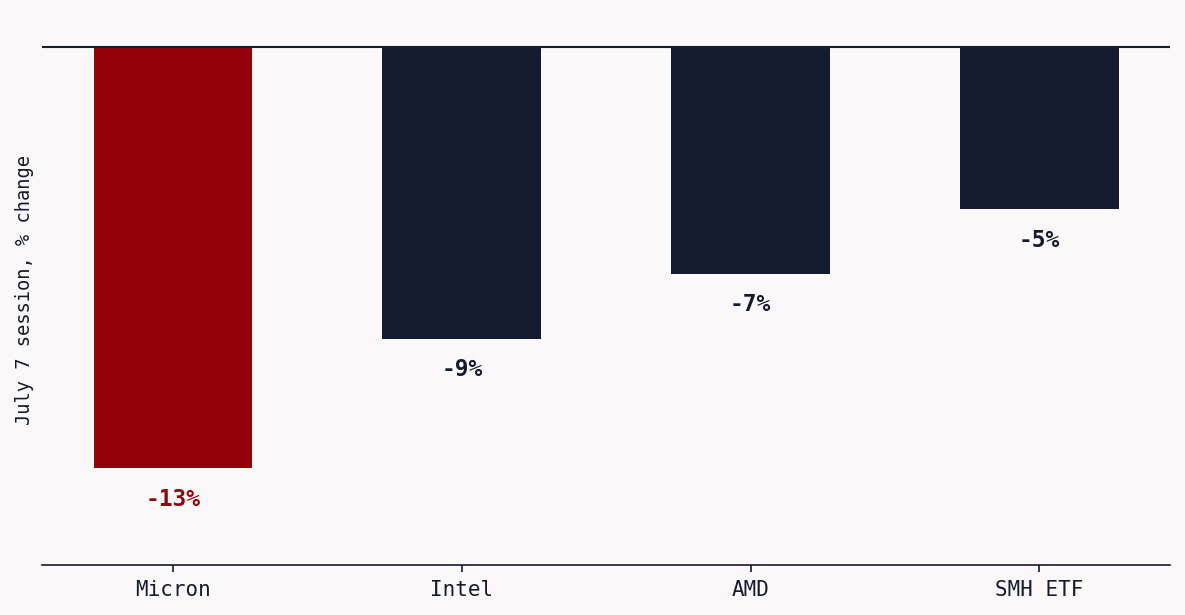
That hawkish backdrop collided with the AI trade. Semiconductor stocks suffered their worst stretch in months, erasing over a trillion dollars in market value at the lows: Micron fell 13% in a single session, Intel 9%, AMD 7%, and the sector ETF shed 5% after a record second quarter. The proximate triggers were reports of SK Hynix slowing memory expansion and Samsung earnings that missed an exalted AI bar, but the underlying anxiety is simpler: whether record AI capital spending can pay for itself with rates going the wrong way.
The read: last week's semi selloff looked like rotation. This week's had a macro engine attached. Tuesday's CPI print, released the same day Warsh testifies to Congress, is now the single most important data point of the month.
4. Ukraine goes after Russia's oil, 2,500 km deep
The other oil war escalated sharply while attention sat on the Gulf. Ukraine conducted its deepest strike of the entire conflict, hitting the Omsk refinery in Siberia, Russia's largest, more than 2,500 kilometres from the border. By Friday it had struck 18 vessels in a single night, 13 of them tankers, along with another refinery and an oil terminal. Russia answered with one of the heaviest bombardments of the war: 68 missiles and 351 drones at Kyiv on Monday, killing at least 27 people on the eve of the NATO summit, where President Trump arrived fresh from a 90 minute call with Vladimir Putin that the Kremlin called "businesslike".
Energy markets have largely stopped pricing Ukraine risk, a point made in this publication's first issue. That looks increasingly like a blind spot. A campaign systematically targeting Russian refining capacity and tanker logistics is a supply story, not just a war story, and it is compounding at the exact moment Hormuz has turned unreliable again.
The read: two separate threats to oil supply are now escalating simultaneously, and only one of them carries a risk premium. Worth asking which is mispriced.
Selected chip stocks, July 7 session decline · Source: Yahoo Finance
Week of July 6 to 12, 2026
- 3
- Commercial vessels struck in the Strait of Hormuz
- ~$76
- Brent crude, up roughly 5% on the week
- 188,000
- Barrels per day OPEC+ adds in August, a fifth straight rise
- 2,500 km
- Depth of Ukraine's strike on the Omsk refinery, its longest yet
- 9 of 18
- Fed officials whose June projections showed a 2026 hike
The week ahead
- Tuesday, July 14: June CPI lands the same day Fed chair Warsh testifies to Congress. With the committee split and the July 28 to 29 meeting looming, this is the number that decides the summer's rate debate.
- The Gulf: whether the Doha talks actually resume after the funeral pause, and whether tanker traffic and shipping insurance rates in Hormuz normalize or deteriorate. Watch the flows, not the statements.
- Trade and earnings: Q2 bank earnings open the season, USMCA renegotiation Round 3 lands July 20, and the Section 122 tariff surcharge expires July 24, a crowded window for anything import-sensitive.
Selected sources
- Washington Post: US and Iran launch fresh strikes after attacks on commercial ships
- CNBC: Oil prices rise after attacks on tankers in Strait of Hormuz
- The National: OPEC+ to raise output for fifth month in August
- US News: Fed split on direction of interest rates at June meeting
- Yahoo Finance: Global chip stocks slump as rate and AI valuation fears trigger selloff
- Critical Threats: Russian Offensive Campaign Assessment, July 6, 2026
- CNN: Deadly Russian strikes hammer Kyiv on eve of NATO summit