The War Reaches the Cushion
For two issues running, the story here was a market that would not flinch. This week the fighting stopped aiming at the shipping and started aiming at the cushion. Covering the week of July 13 to 19, 2026.
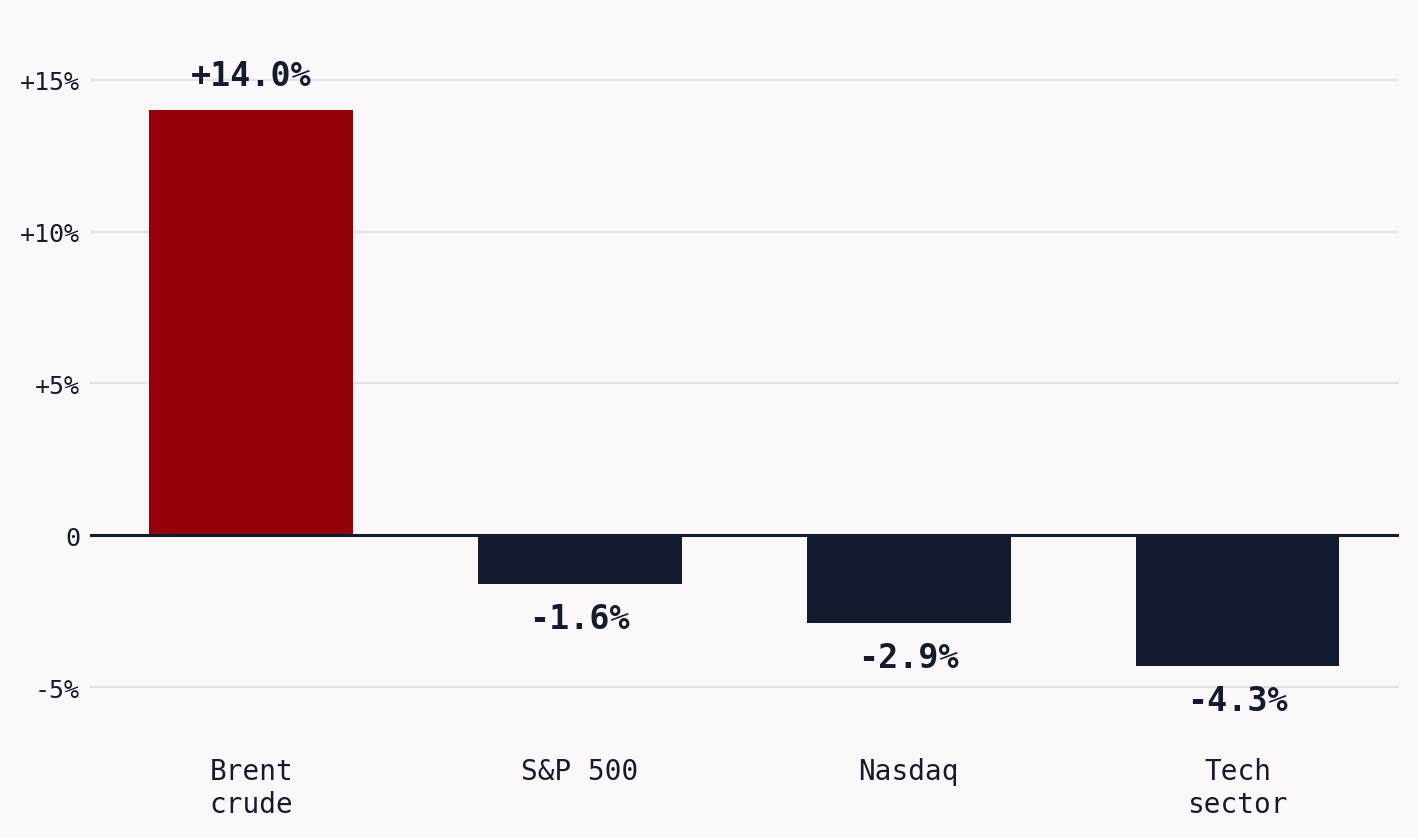
The comfort that carried equities through two weeks of missiles rested on a simple bet: that the Gulf held enough spare oil to absorb almost anything short of the strait itself closing. Traders trusted a cushion of unused barrels sitting behind the fighting. This week the fighting turned toward that cushion. The United States struck Iran for a sixth consecutive night, Iran answered with missiles and drones against American bases and civilian infrastructure across Kuwait, Bahrain and Jordan, and oil finally did what a fortnight of headlines had failed to make it do. Brent closed near $88, up roughly 14% on the week. Stocks slipped. The calm did not break, but for the first time it visibly bent.
1. The war reaches for the cushion
US Central Command said it carried out dozens of strikes to degrade Iran's ability to hit vessels in the Strait of Hormuz, part of a sixth straight night of American attacks after the truce agreed last month collapsed. Iran retaliated not at ships but at the region's plumbing. Its Revolutionary Guard reported striking the Ali Al Salem air base in Kuwait, targeting Patriot batteries, fuel tanks, weapons depots and two HIMARS launchers, and fired ballistic missiles at a US base in Jordan. Bahrain, Iraq, Oman and Qatar were all forced into defensive action. Most telling for markets: Iran hit a Kuwaiti power and water desalination plant, sparking a fire that damaged generating units.
The oil response was, this time, real. Brent touched about $85.92 midweek, the highest since June 15, and closed near $88.10 on Friday for a weekly gain of roughly 14%. Hormuz traffic thinned to 57 transits from Friday to Sunday, a drop of more than 50% from the prior week. Iran's health ministry reported at least 35 people killed since the fighting resumed.
The read: for two weeks the market's composure rested on spare capacity sitting in the Gulf. Now the missiles are landing on the Gulf's own power, water and fuel depots, the physical infrastructure that spare capacity depends on. A cushion you cannot reach is not a cushion. The honest gauge from here is not the casualty count, it is whether the next thing to catch fire is a loading terminal or a pipeline rather than a radar.
2. The disinflation everyone cheered is already gone
Tuesday brought the June inflation report, and it was soft in every line traders wanted. Headline CPI rose 3.5% year on year, down sharply from 4.2% in May and below the 3.8% consensus. Prices fell 0.4% on the month, the first monthly decline in about six years, driven by a 5.7% drop in energy. Core inflation held at 2.6%. Markets read it as a green light for easier policy. There is one problem with that reading: June's survey window closed before this week's oil surge existed.
Fed chair Kevin Warsh, testifying to Congress hours after the print, declined the victory lap. "There might be some that look at this morning's data and say, oh, mission accomplished. Everything is swell. That is not my view." The committee is holding its target range at 3.50% to 3.75%, and Warsh offered no forward guidance beyond a plain refusal to declare the job done.
The read: the number that cheered the market measured a world that no longer exists. June's disinflation was largely an energy story, and energy has spent this week travelling hard in the opposite direction. The July report, due August 12, will carry the oil spike that the June data was too early to see. Warsh is not being coy; he is looking at the same tape as everyone else and doing the arithmetic. The cut that softer data seemed to invite may have been overtaken by events within 48 hours of printing.
3. Wall Street's volatility dividend
Bank earnings opened the season on Tuesday, and JPMorgan set the tone with numbers that headlines called historic: net income of $21.2 billion, earnings of $7.70 a share against $5.55 expected, revenue of $58 billion, and profit up 41% from a year earlier. The bank lifted its quarterly dividend to $1.65. Across the market the beats were broad, with roughly 90% of the first 49 S&P 500 companies to report topping estimates.
Two caveats sit under the headline. About $5.6 billion of JPMorgan's pretax gains were one-time items, chiefly a $4.6 billion gain on Visa shares plus a billion in other equity gains. And the underlying strength was concentrated in trading and investment banking, the desks that earn most when markets lurch. This was a quarter that markets lurched a great deal.
The read: the same volatility repricing oil and denting the Nasdaq is a revenue line for the banks that sit in the middle of it. Strip the Visa windfall and it is a strong quarter, not a historic one. Worth remembering the next time a bank result is read as a verdict on the "real economy": trading desks are paid to profit from precisely the turbulence the rest of the market is trying to survive.
4. The second oil front gets a sponsor
While the Gulf filled the screens, the other war on oil supply gained a political accelerant. A bipartisan group of senators reached agreement with the Trump administration to advance the long-stalled Russia sanctions bill, championed by the late Senator Lindsey Graham, which threatens steep secondary tariffs on countries that keep buying Russian energy. The president signaled his support, a shift that puts real weight behind a measure that had sat idle for months. On the ground, Ukraine struck the Salavat oil refinery overnight on July 13 to 14, the last major Russian refinery it had not already hit this year, while downing five of eight ballistic missiles in one of Russia's long-range barrages, a notably higher interception rate than before.
The read: two threats to oil supply now sit on the same table, and this week the Russian one acquired a sponsor in Washington. Secondary sanctions on buyers of Russian crude would tighten the very barrel market the Gulf is already straining. The question this publication has asked issue after issue is which oil risk is mispriced. The answer may increasingly be the one that arrives by legislation rather than by missile.
Weekly change, July 13 to 17 session · Source: weekly market recap
Week of July 13 to 19, 2026
- ~$88
- Brent crude on Friday, up roughly 14% on the week
- 3.5%
- June headline CPI, down from 4.2% in May
- -0.4%
- June's monthly CPI, the first decline in about six years
- +41%
- JPMorgan's year-on-year jump in second-quarter profit
- 57
- Hormuz transits from Friday to Sunday, a drop of over 50%
The week ahead
- Monday, July 20 onward: whether the US-Iran fighting runs into a second week, and crucially whether the strikes move from radars and bases to the Gulf's loading terminals and pipelines. Watch Hormuz tanker traffic and war-risk insurance rates, not the casualty count.
- The Fed, July 28 to 29: the oil surge lands just before the meeting. With June inflation soft but July's number set to reverse on energy, watch how a divided committee squares a rear-view print against a forward-looking shock.
- Earnings and trade: mega-cap technology earnings begin, the Graham Russia sanctions bill moves through the Senate, USMCA renegotiation Round 3 arrives July 20, and the Section 122 tariff surcharge expires July 24.
Selected sources
- CNBC: Oil rises after Kuwait says Iran attacked desalination and power plant
- CNBC: Consumer price index inflation report, June 2026
- CNN: Takeaways from Fed chair Kevin Warsh's first congressional testimony
- Crypto Briefing: Major banks post historic Q2 2026 earnings as trading surges
- CNN: Bipartisan senators announce agreement with Trump administration on Russia sanctions
- Critical Threats: Russian Offensive Campaign Assessment, July 14, 2026