The Price of a Phone Call
Brent fell 11% on a rumour of talks and rose 1% on missiles hitting tankers inside the Strait of Hormuz. Six central bankers spent the same week voting to raise rates over an energy shock the oil market had just marked down. Covering the week of July 27 to August 2, 2026.
For three issues this publication has asked which of the two threats to oil supply was mispriced, and issue three answered that it was probably the one arriving by legislation rather than by missile. On Wednesday the Senate voted 86 to 12 to advance it. In the same five days Iran's Revolutionary Guard put missiles into two tankers inside the strait itself, under American air escort, and Brent still finished the week down more than 5%. Both halves of that sentence are true and they do not sit together comfortably. Six policymakers in Washington and London voted to raise interest rates because of an energy shock, and the energy market spent the identical week discounting it.
1. Brent pays 11% for a phone call and 1% for a missile
Monday did the damage. Brent closed at $85.87, down 11.3%, with US crude off about 7% to $82.61, after Oman's foreign minister spent the day working the phones with Iran, Saudi Arabia, Qatar, Kuwait and Egypt, and President Trump said he had held off on new strikes because mediators reported progress. His account of it was that Tehran "asked us very nicely, 'Please stop, let's meet.'" No barrel was added to the market on Monday. No tanker was unloaded. A mediator made some calls and the world's most traded commodity repriced by eleven percent.
Friday tested the other direction. The Revolutionary Guard said it had struck two tankers attempting to transit routes Iran had not authorised, escorted by American military aircraft, and four more turned around and sailed back to where they came from. This is the scenario the entire risk premium was built for: shots fired inside Hormuz, at ships under US escort, with vessels abandoning the passage. Brent settled at $90.12, up 1.2% on the day and down more than 5% on the week. July as a whole closed 24% higher, the strongest month since March.
The read: the market moved roughly nine times as far on a mediator's phone call as on the first confirmed strike against escorted shipping in the strait. That is not a market pricing barrels. It is a market pricing the odds of a handshake, and treating the physical war as noise around the diplomatic signal. Fine, as long as the diplomacy is real. What is the trade if the calls were only ever a way of buying time between strikes?
2. Six central bankers vote to raise rates and lose
The Fed held its target range at 3.50% to 3.75% on Wednesday, and three voters broke ranks: Beth Hammack of Cleveland, Neel Kashkari of Minneapolis and Lorie Logan of Dallas, all for a quarter point higher. Three dissents pointing the same way is the first such split since September 2016. Kevin Warsh, in his second meeting as chair, sounded almost pleased about it: "I asked for a good family fight, and I got one."
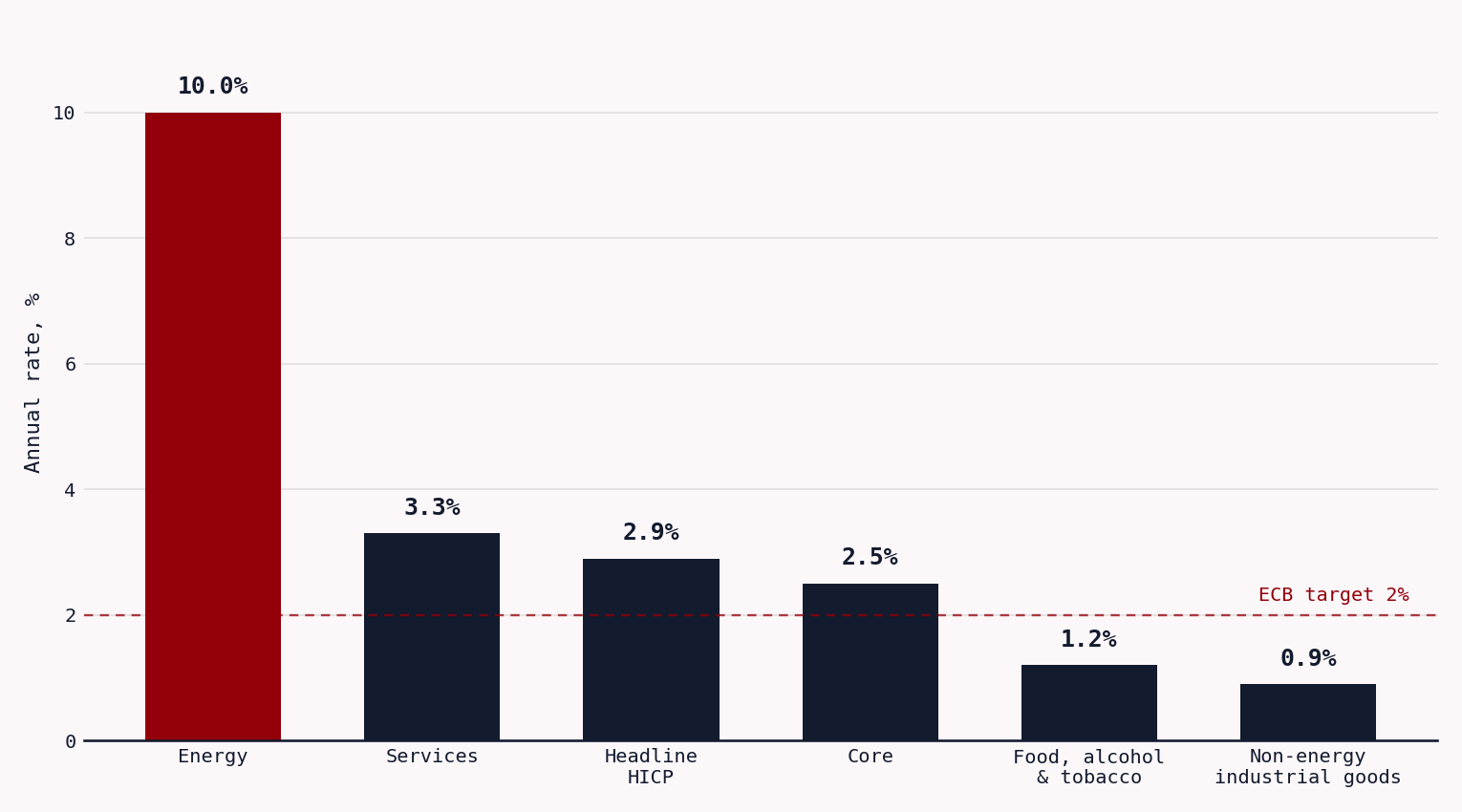
London produced the same shape a day later. The Bank of England left Bank Rate at 3.75% for a fifth consecutive meeting on a 6 to 3 vote, with Huw Pill, Megan Greene and Catherine Mann all voting for 4% on the argument that higher energy prices are becoming persistent rather than passing through. And on Friday Eurostat published the number that explains both minorities. Euro area inflation rose to 2.9% in July from 2.8%, core to 2.5% from 2.4%, and energy to 10.0% from 8.5%. Food actually decelerated. Industrial goods barely moved. One line is doing all the work.
The read: an oil shock does not have to break a central bank's forecast to split its committee, it only has to make the back half of that forecast unfalsifiable for another quarter. Six officials looked at double-digit energy inflation and voted to act on what they could already see. The majorities looked at the same number and chose to wait for a print that has not happened yet. Which of those two groups is actually the one making a forecast?
3. Warsh subcontracts the tightening to a 5.21% bond market
Warsh declined to hike and offered a more interesting reason than caution. He praised the run-up in long yields since the June meeting, arguing it was doing useful work for the central bank and might mean officials do not need to move at all. The bond market answered him while he was still at the podium. The 30-year yield went from about 5.1% to 5.21% during the press conference, its highest since 2007, and the 10-year from just above 4.61% to nearly 4.69%, closing the week at 4.74%. Investors were not congratulating him on the free tightening. They were charging him for it.
The quarter underneath all this arrived Thursday and was worse than the headline suggested. Real GDP grew at a 1.5% annual rate in the second quarter against 2.1% expected and 2.1% delivered in the first, while the PCE price index for the quarter ran at 5.1%, up from 4.6%. Slower growth, faster prices, in the same release. Equities took none of it personally: the S&P 500 and the Dow each added about 1% on the week and the Nasdaq 1.6%, powered by Amazon jumping more than 15% on Friday after a spring profit that vindicated its capital spending, while Apple fell about 7% on a soft revenue forecast and Meta dropped roughly 9% for refusing to commit on capex. Issue four called the American benchmark an index of two stocks. It is now an index of two stocks pointed in opposite directions, which at least looks more like a market.
The read: a chairman who says higher long yields are doing his job for him has quietly outsourced his mandate to the one market that gets to grade him on it. Those yields are not a gift. They are a running score on whether anyone believes the Fed will act before the energy shock reaches the core, and 5.21% on the 30-year is not a passing mark.
4. Eighty-six senators price the other oil war
The Lindsey O. Graham Sanctioning Russia Act cleared its procedural vote 86 to 12 on Wednesday, with Volodymyr Zelensky watching from the gallery days after the funeral of the senator whose name it now carries. The bill authorises tariffs of up to 100% on the five largest foreign buyers of Russian crude and gas, which means China and India, with carve-outs for countries taking less than 15% of their gas from Russia and cutting. It sat idle for the better part of a year. It is now three votes from a president who has said he wants it.
Issue three argued that the mispriced oil risk was the one that would arrive by legislation rather than by missile, at a point when that looked like a slightly contrarian stretch. An 86 to 12 vote is not the profile of a bill that stalls.
The read: a tariff wall around the buyers of the world's second largest crude exporter is a supply event wearing the costume of a trade measure, and it is closer to law than at any point in this war. Brent spent the week falling anyway. How much of that discount is a genuine read on barrels, and how much is a bet that Washington writes the threat and never sends it?
Euro area annual inflation by component, July 2026 flash estimate · Source: Eurostat
Week of July 27 to August 2, 2026
- 11.3%
- Brent's fall on Monday, to $85.87, on reports of an Omani diplomatic push
- 6
- Fed and Bank of England policymakers who voted to raise rates this week, and lost
- 10.0%
- Euro area energy inflation in July, against 8.5% in June
- 5.21%
- The 30-year Treasury yield during Warsh's press conference, highest since 2007
- 86 to 12
- Senate vote to advance tariffs on the largest buyers of Russian oil and gas
The week ahead
- OPEC+, Sunday: delegates have an agreement in principle to add about 188,000 barrels per day in September and then pause for the fourth quarter, which would finish unwinding the 1.65 million barrel cut agreed in 2023. The pause is the part worth reading, because it is where the argument over new quotas starts.
- July payrolls, Friday: the first labour reading fully inside the oil spike, landing on a committee that has just seen three of its members vote to tighten. A soft number does not settle the argument; it changes which side has to explain itself.
- The Senate floor and the strait: whether the Graham bill survives the exemption fight intact, and whether the four tankers that turned back on Friday become forty. Hormuz transit counts remain the honest gauge, not the statements around them.
Selected sources
- CNN: US pauses new strikes as Oman leads a regional diplomatic push
- CNBC: Oil prices rise after Iran says it attacked two tankers transiting the Strait of Hormuz
- CNN: Two key takeaways from the Fed's unusually unpredictable meeting
- CNBC: 30-year Treasury yield hits highest level since 2007 after the Fed keeps rates unchanged
- Fortune: Bank of England keeps interest rates at 3.75% for a fifth time this year
- Eurostat: Euro area annual inflation up to 2.9%, flash estimate for July 2026
- Bureau of Economic Analysis: Gross domestic product, second quarter 2026, advance estimate
- Axios: 86 senators vote to move forward with the Graham Russia sanctions bill